

How to Save Water and Increase Home Value with Water-Efficient Kitchen and Bath Products
Orlando, Florida—Feb. 16, 2026—With more choices for kitchen and bath products on the market than ever, Plumbing Manufacturers International’s Rethink Water initiative today encourages shoppers to choose certified, water-efficient products that increase home value while reducing water and energy bills. PMI and its members gather this week for the Kitchen and Bath Industry Show (KBIS), Feb. 17-19 in Orlando.
“Water-efficient toilets, faucets and showerheads have earned high customer satisfaction because they are reliable, durable and save water,” said PMI CEO/Executive Director Kerry Stackpole. For these reasons, water-efficient products are a high-growth category across the housing market, he added. “These high-performing products are popular among eco-conscious buyers who value sustainability and long-term cost savings,” he explained.
Look for the WaterSense label
The easiest way to shop for these water-efficient products is to look for products certified by the Environmental Protection Agency’s WaterSense program. Products for the home include toilets, faucets, showerheads, lawn sprinkler systems, and point-of-use reverse osmosis water treatment systems that remove contaminants such as lead, PFAS and bacteria. Commercial products include urinals and outdoor irrigation or sprinkler systems.
Since their introduction about 20 years ago, WaterSense products have saved more than 10 trillion gallons of water. A certified WaterSense product meets high performance criteria while reducing water use by 20% or more compared to products meeting the federal water-efficiency standard. A WaterSense toilet uses 1.28 gallons per flush (gpf) or less, 20% less than the federal standard of 1.60 gpf. WaterSense bathroom faucets use 1.5 gallons per minute (gpm) vs. the 2.2 gpm federal standard, and WaterSense showerheads 2.0 gpm vs. the federal standard of 2.5 gpm.
PMI member companies produce water-efficient products in a wide range of styles and prices. More than 46,000 WaterSense product models can be found online and in retail and wholesale showrooms around the world. If you decide to shop, find productsby manufacturer and see if rebates are available in your area.
How to maximize water efficiency in the home…
- Replace older, inefficient toilets. Studies commissioned by PMI estimate that replacing all the older, inefficient toilets with water-efficient models could save billions gallons of water within only a few years, with the exact number depending on how many toilets were replaced. If your toilet was manufactured before the implementation of the Energy Policy Act (EPAct) in 1994, there’s a good chance it uses water inefficiently. Today’s water-efficient toilets have earned high consumer satisfaction ratings, according to Consumer Reports, so there is no reason to be concerned about flushing power and cleanliness. Toilets account for about 30% of the indoor water use in the average home, according to the Environmental Protection Agency (EPA).
- Replace or upgrade faucets. Faucets account for about 15% of indoor household water use, according to the EPA. WaterSense faucets can reduce the water you use at sinks by at least 20%. Some faucets may be upgraded with an aerator to be made more water efficient.
- Get a water-efficient showerhead. Showerheads use about 20% of the water in an average home, according to the EPA. Swapping out your old showerhead for a new one can save water and money while providing outstanding performance and safety. Always be sure that the shower valve is sized to fit your showerhead.
- Eliminate leaks and prevent waste and damage caused by them. Look for and repair any water leaks in faucets, toilet flappers, and so forth. Smart plumbing products, such as leak detectors, shut-off valves, and brain pipe technology, can save water and prevent damage in the case of a leak.
- Shorten the distance hot water travels. There’s nothing mysterious about it. The farther the heat source—whether a water heater, a heat pump or a boiler—is located from the shower or faucet, the longer it takes the hot water to arrive. Water is wasted while you wait for the right temperature. To get hot water faster and reduce waste when building or remodeling a home, consider:
- Placing the water heater close to the shower to have a shorter-pipe run.
- Smaller-diameter pipes that hold less water.
- A recirculating pump to keep water hot in the water pipes.
- A point-of-use, on-demand heater near distant taps. - Water reuse. Newer buildings have onsite systems that capture, treat and recycle water for non-potable or outdoor uses such as toilet flushing, cooling and irrigation. These systems generally use dual plumbing systems that separate potable and non-potable water.
Here’s more you can do in commercial spaces…
- Conduct a water inventory to determine the flow rate of all toilets, faucets, showerheads, urinals, and outdoor sprinkler systems. Any using more than current federal water-efficiency standards should be upgraded immediately.
- Switch to water-efficient valves. Replace commercial kitchen pre-rinse spray valves with water-efficient models.
- Ease the pressure. Consider reducing the water pressure of your entire plumbing system.
- Cut outdoor water waste. The WaterSense label is not just for plumbing products, but also for irrigation controllers and irrigation-training programs for landscape professionals. The label identifies water-efficient products and verifies professional proficiency in water-efficient irrigation system design, installation, maintenance, and performance audits.
Learn more at safeplumbing.org/rethinkwater.
Download infographics:
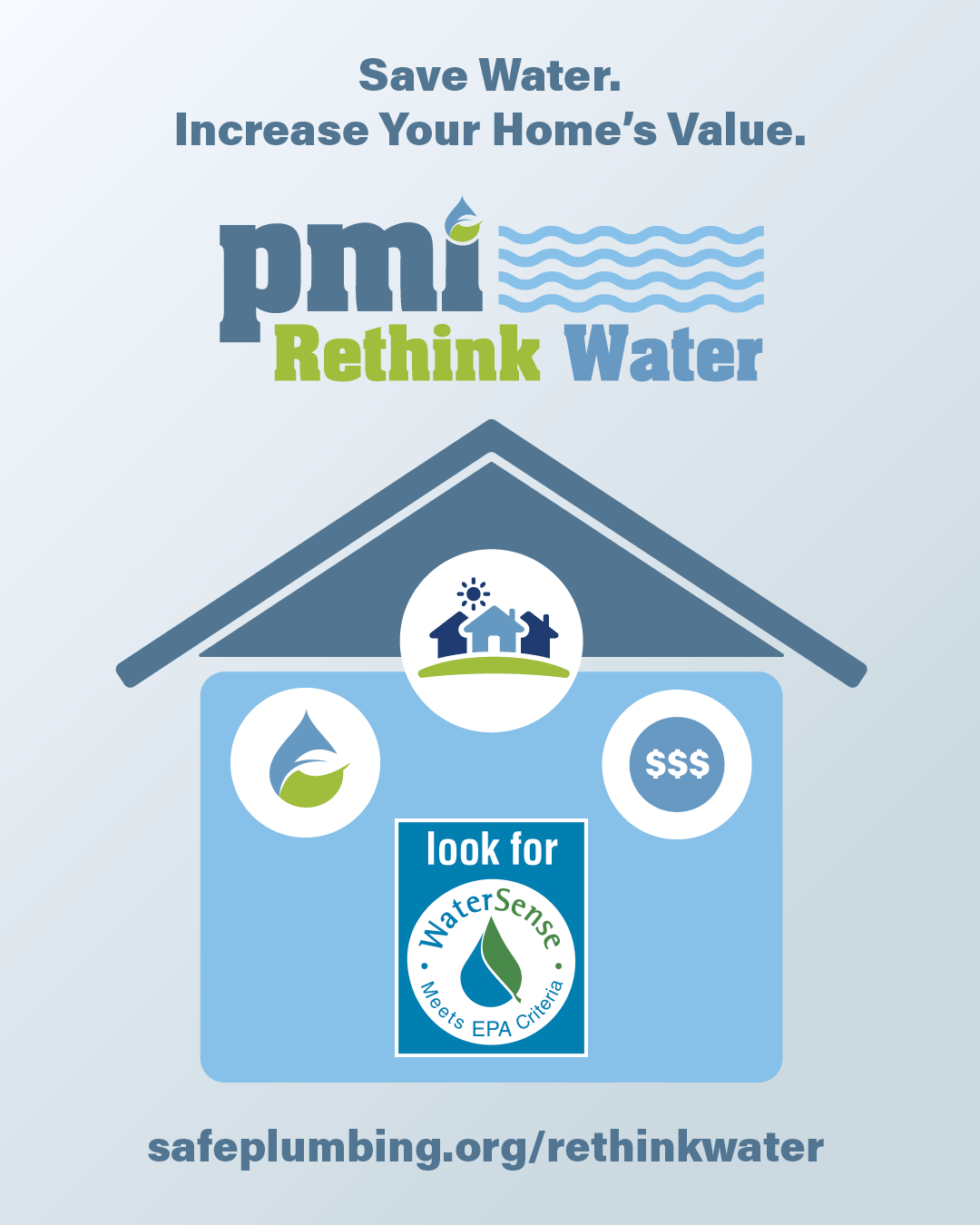
Save Water. Increase Your Home’s Value (Vertical portrait) (Horizontal)
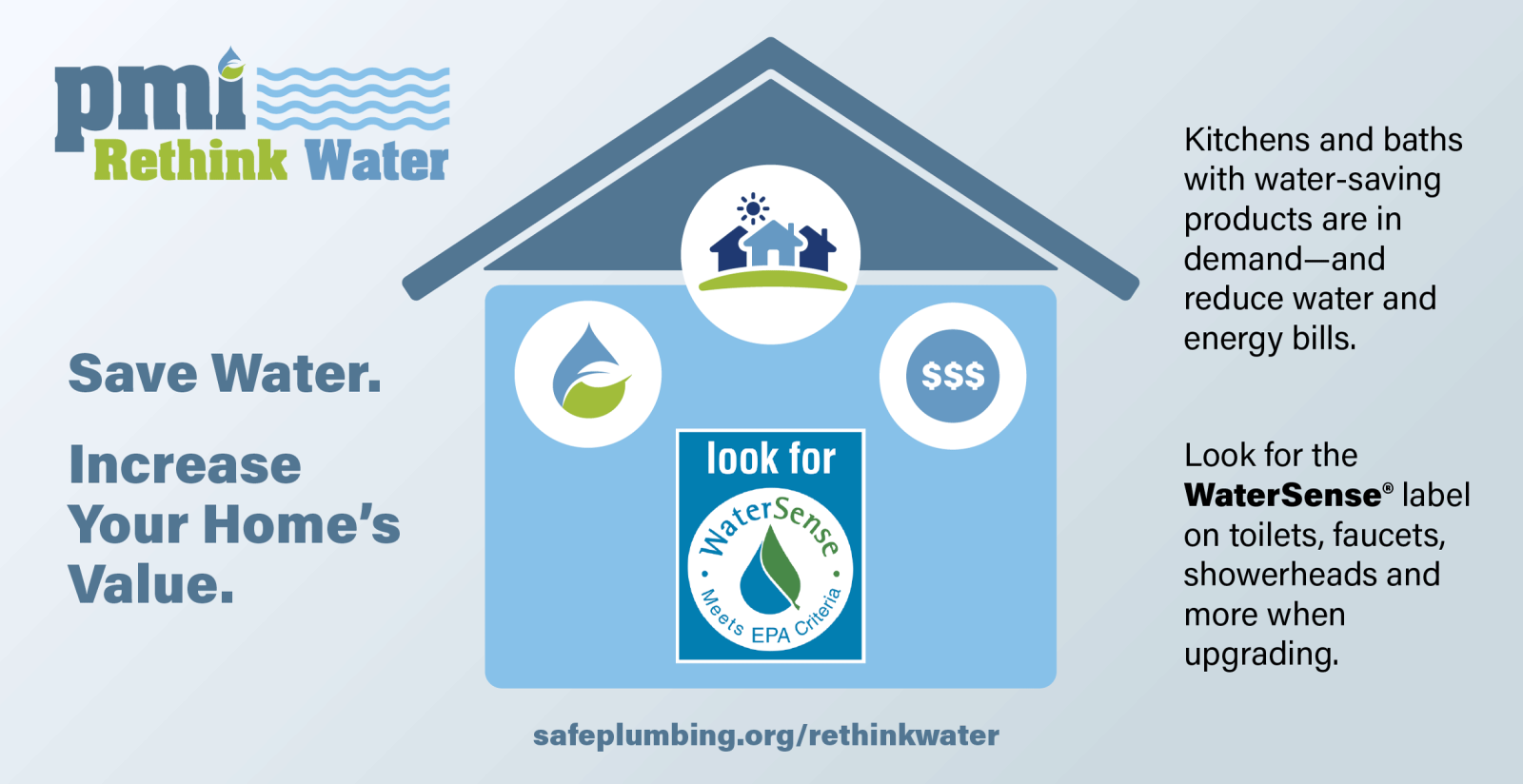
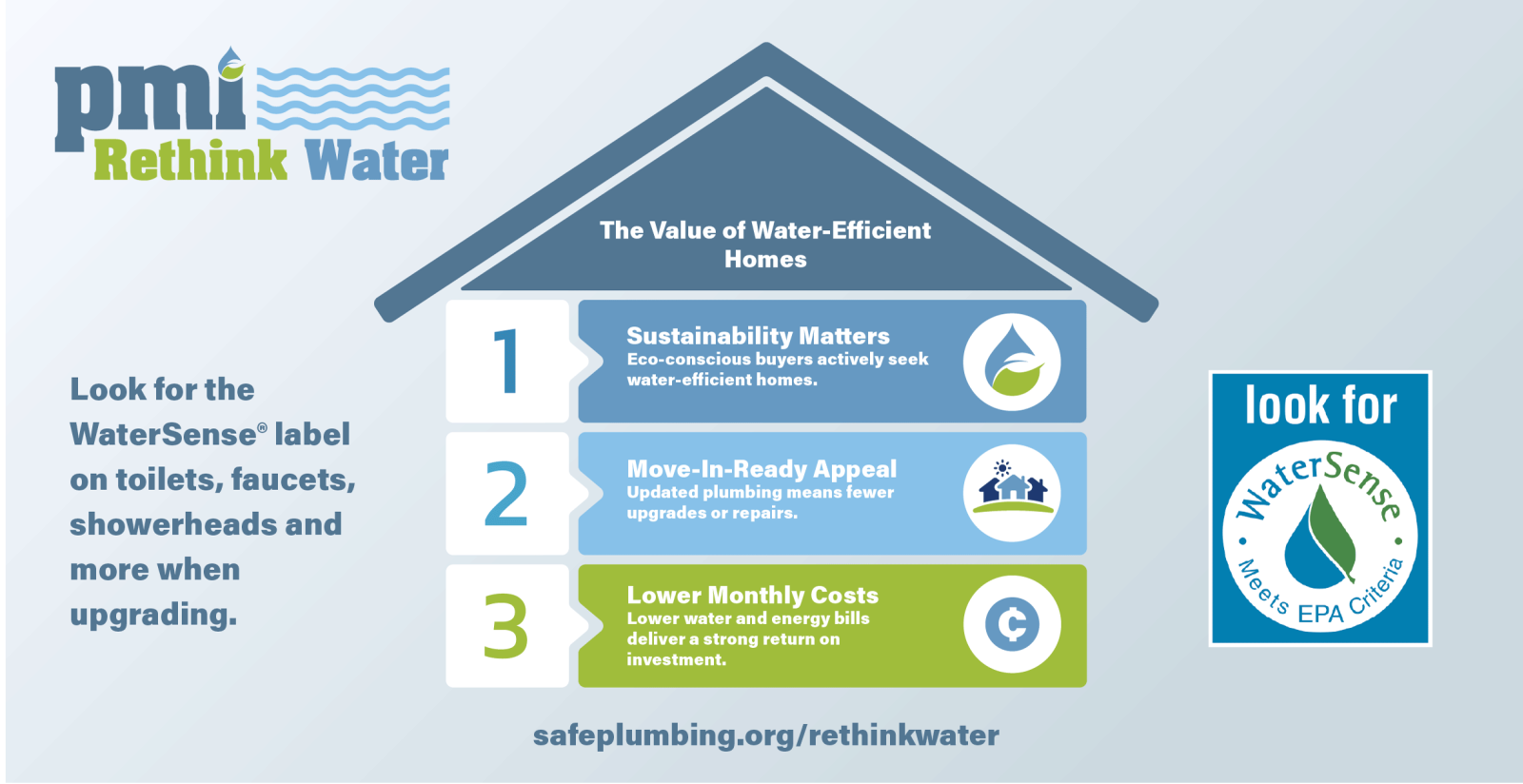
The Value of Water-Efficient Homes (Vertical portrait) (Horizontal)
Water Efficiency is Good for the Planet (Vertical portrait) (Horizontal)
About Plumbing Manufacturers International
Plumbing Manufacturers International (PMI) is the trade association of plumbing product manufacturers that produce more than 90% of the United States’ plumbing products, represent more than 150 iconic brands, and develop safe, reliable and innovative water-efficient plumbing technologies. PMI members contribute 517,696 jobs and $116.7 billion in economic impact to America's economy, according to the Plumbing Manufacturing Industry Economic Impact Study.
With a vision of safe, responsible plumbing – always, PMI advocates for plumbing product performance contributing to water efficiency and savings, sustainability, public health and safety, and consumer satisfaction through its Rethink Water initiative and other programs. PMI members manufacture water-efficient toilets, urinals, faucets, showerheads and other products at more than 70 locations across the country and market them online and in more than 26,000 home improvement stores, hardware stores and showrooms in all 50 states. For more information on PMI, contact the organization at 1750 Tysons Blvd., Ste. 1500, McLean, Va., 22102; tel.: 847-481-5500; fax: 847-481-5501. safeplumbing.org.
Contact for PMI: Ray Valek, ray@valekco.com, 708-352-8695