

January 2026
Let’s Continue Our Industry’s Innovation, Resilience and Growth
 By Bob Neff, PMI Board of Directors President, Delta Faucet Company
Plumbing Manufacturers International stands at the heart of an industry that quite literally keeps modern life flowing. Plumbing products manufacturing is not only about fixtures and fittings—it is about safeguarding health, advancing water efficiency, and building the systems that sustain our communities every single day.
I am deeply honored—and genuinely humbled—for the opportunity to serve as your 2026 president. Also, on behalf of the PMI Board of Directors and the entire membership, I am grateful to follow and celebrate the leadership of 2025 PMI board president Belinda Wise. We thank her for everything she has done for PMI and its members these past many years.
A mission of innovation, problem solving and stewardship
Our association’s mission—to represent, advocate for, and elevate the work of U.S. plumbing manufacturers—is both vital and deeply meaningful. We are innovators, problem-solvers, and stewards of an industry that blends engineering precision with environmental responsibility.
I follow in the footsteps of leaders and volunteers who have given so much to build this organization and strengthen our collective voice. I am profoundly grateful for their example—and for all of you who give your time, insight and passion to advance our shared cause.
The challenges ahead are real: evolving regulations, global competition, and the accelerating pace of technology. But so are the opportunities—to lead on sustainability, to shape sound public policy, and to tell the powerful story of American manufacturing excellence.
My commitment to you
As I begin this role, my commitment is simple: to listen, to collaborate, and to lead with purpose—so that together we continue building an association worthy of the people and the industry it represents. Thank you for your trust, your partnership, and for everything you do to keep this industry strong.
The plumbing fixture and fittings manufacturing industry has always been a pillar of innovation, resilience, and economic growth. It is our responsibility to ensure it continues to thrive for another 70-plus years, adapting to new realities while staying true to our core values.
I look forward to working with all of you as we embark on this exciting new chapter. Together, I am confident that we will not only face the challenges of the future but shape the future itself.
Let’s look forward to PMI26 in New Orleans
The PMI26 Manufacturing Success Conference and 72nd Meeting of the Membership will be held in one of the most exciting, dynamic and fun-loving cities in America. We look forward to having you join us in New Orleans at the fabulous Loews Hotel for PMI26.
In the meantime, let’s resolve to engage ourselves to finding solutions to the challenges we face and be thankful for the opportunities we have. Let’s make 2026 another year of action, progress and, ultimately, celebration.
Drivers of Optimism for 2026
 By Kerry Stackpole, IOM, FASAE, CAE, PMI CEO/Executive Director
The late Secretary of State and U.S. Army General Colin Powell famously said, “Perpetual optimism is a force multiplier.” In his world experience, he saw optimism as a means to drive a team’s effectiveness beyond its actual size or resources, acting as a contagious, empowering force that boosts morale, creativity and resilience to overcome challenges. It’s a leadership tool that makes a group more capable and powerful than its design alone would suggest. For many leaders, an optimistic posture takes on what psychologists call “optimistic realism.” It’s the ability to envision a better future while acknowledging the effort, trade-offs and discipline required to achieve it.
So, perhaps it is no surprise our first essay for 2026 is all about a renewed sense of optimism we see emerging across leadership teams, supply partners, and our sister industry associations. After several years of navigating volatile supply chains, shifting regulatory landscapes, and economic uncertainty, PMI members are entering the new year with clearer visibility, stronger operational resilience, and expanding opportunities for growth. Several key forces are shaping this improved outlook, signaling that 2026 could be a pivotal year for the industry.
Improved regulatory predictability
Perhaps the most significant contributor to rising confidence is the expectation of improved regulatory predictability in 2026. Plumbing Manufacturers International members have long faced challenges related to tariffs on raw materials, component imports, and finished goods—pressures that have influenced both pricing strategies and sourcing decisions. Over the past year, as proactive policy advocates, PMI has gained clearer insights into tariff structures and trade negotiations, enabling member companies to plan more effectively and hedge risk more strategically.
Federal regulatory agencies such as the Environmental Protection Agency are providing transparent guidance on emerging issues such as lead content, PFAS restrictions, and water-efficiency requirements. Although compliance expectations continue to intensify, PMI members now have better foresight into timelines, testing requirements, and certification pathways. This added clarity allows research and development and compliance teams to shift from defensive posture to proactive innovation, encouraging their companies to bring new, compliant products to market with confidence.
Manageable inflation and interest rates
After a period of elevated inflation and high borrowing costs that constrained both construction activity and capital investment, PMI economists project stable inflation and possible interest rate reductions throughout 2026. For PMI member companies, this creates multiple tailwinds: lower input cost volatility, improved affordability for residential and commercial projects, and more favorable conditions for financing plant upgrades, automation investments, and product development initiatives. Capital-intensive projects—such as tooling, robotics, and facility expansion—become more financially feasible when borrowing costs lessen. There are financial indicators that member companies will be able to resume delayed investments that will enhance capacity, reliability and competitiveness.
Resilient supply chains
One of our industry’s bright spots over the past several years is the active re-evaluation of supply chains, establishing redundancy and building stronger relationships with domestic suppliers. These efforts are now paying real dividends. Companies report shorter lead times, improved inventory visibility, and greater control over material availability heading into 2026. The resulting resilience provides leadership teams with greater confidence in meeting customer delivery expectations and reducing the risk of production stoppages. In addition, the integration of digital supply chain tools—such as real-time tracking and predictive analytics—has enhanced forecasting accuracy and reduced uncertainty.
At the forefront of water stewardship
PMI members have long been at the forefront of water stewardship advancing a wave of product innovation that favor end-users and the planet. Regulations, building codes, and rebate programs continue to promote water-efficient fixtures. Meanwhile, consumers and commercial owners increasingly prioritize sustainability in purchasing decisions. This alignment between regulatory pressure and market preference offers plumbing manufacturers a unique opportunity to differentiate and grow.
Many companies anticipate strong demand for ultra-high-efficiency faucets, showers and toilets—particularly in drought-affected regions and high-performance building markets. Beyond water savings, sustainability initiatives related to recycled materials, lower-carbon manufacturing, and long-life product design are creating new competitive advantages for brands willing to invest in environmental leadership. You can’t talk about innovation without illuminating the steady growth of smart, touchless, and sensor-enabled plumbing fixtures. After early experimentation, adoption is accelerating across both residential and commercial segments. Improved connectivity, declining sensor costs, and heightened expectations for hygiene and remote monitoring are fueling a healthy demand.
Taken together, all these factors—regulatory clarity, economic stabilization, resilient supply chains, sustainability momentum, smart-technology adoption, and a more capable workforce—form a compelling foundation for optimism and leadership in 2026.
PMI Tests Fake Products to Show Extent of Problem to Feds
 By Ray Valek, PMI Communications Team, Valek and Co.
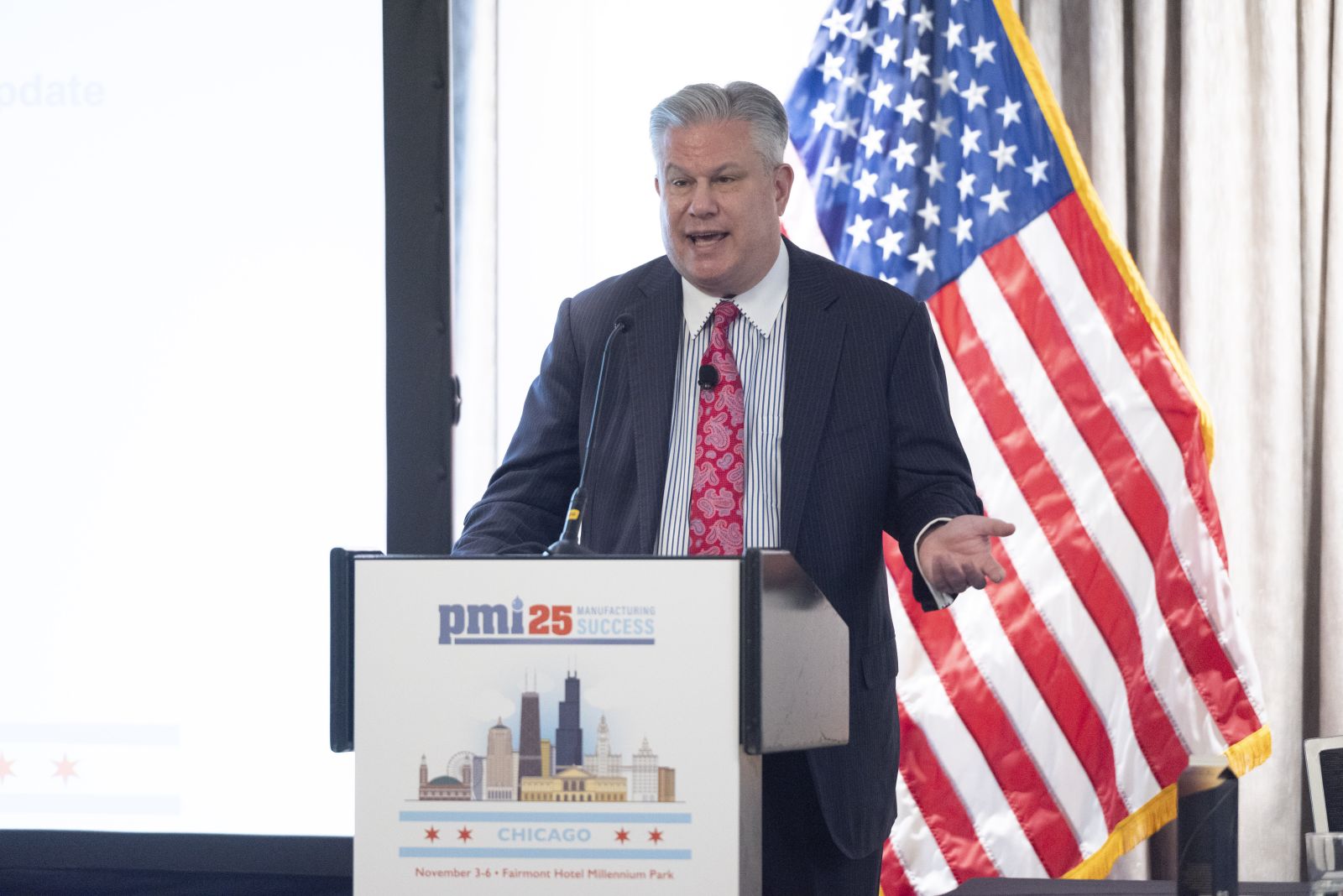
Plumbing Manufacturers International is conducting independent testing of counterfeit and contraband products as part of an effort to show the extent of the problem to federal agencies, said Larry Rosenberg, partner, Jones Day, the firm guiding PMI in its response to uncertified plumbing products in the marketplace. He summarized PMI’s approach to attendees of the PMI25 Manufacturing Success Conference.
Once the testing confirms safety hazards, noncompliance with regulations, and false or misleading product information, PMI plans to ask federal agencies to enforce statutes and other safety standards in ways they’re not doing now, he explained.
Estimating as many as 35 million “cheap, foreign-made, off-brand” faucets sold in the United States in the last five years, Rosenberg referred to Moen’s testimony about cheap, knock-off faucets to Congress in May and to IAPMO’s assistance in testing these faucets, 17 of 19 of which did not meet drinking water health and safety standards. He echoed Moen’s warning that the threat of fake products is “likely to become more acute as imposter brands leverage advanced AI technologies capable of creating more deceptive advertising and faster replication of IP (intellectual property) from the manufacturers who are genuine.”
Report fake products to PMI and federal agencies
Rosenberg encouraged all PMI member companies to report any fake products they encounter to PMI and to appropriate federal agencies. “Self-policing is important and getting anecdotal information from all of you is a critical first step. Because you’ll know sooner than anybody if there are counterfeits of your products coming into the stream of commerce,” he emphasized.
Rosenberg provided an overview of statutes that regulate plumbing products, as well as federal agencies that might be persuaded to intervene on the plumbing manufacturing industry’s behalf. Statutes include the Energy Policy and Conservation Act, INFORM Consumers Act, and Consumer Product Safety Act. Federal agencies include the Department of Energy, Federal Trade Commission, Customs and Border Protection, Consumer Product Safety Commission, and the Environmental Protection Agency.
Building a case to enforce violations
While statutory violations have clearly occurred, the challenge is convincing one or more of the agencies to enforce violations, he explained. The Trump administration has indicated a desire to create more of a pro-American business environment through actions such as the elimination of the de minimis exception for import duties and the levying of tariffs; however, the administration has concurrently reduced staff and budget needed to conduct enforcement, Rosenberg stated.
“(Federal agencies) obviously have their hands full with a lot of things going on right now in the administration. But because there has been such an emphasis on tariffs and imports, and how that all gets enforced, I do think there is an opportunity and a potential synergy to add to that discussion about the counterfeit products,” he said.
“When you look at all of the different sources of authority and the different agencies who have jurisdiction here, any one of them could take significant action and help curtail the problem,” Rosenberg explained.
“That’s a source of optimism… Now is a good time to go to the administration and ask them for help if it will promote U.S. business. And if it helps U.S. consumers as well, that’s a good double strength that you can present to the agencies.”
To review the slides from Rosenberg’s presentation, PMI members can log in and go to tinyurl.com/4crzmtnd.
This article is not intended as legal advice. Companies should seek legal counsel specific to their needs and situation.
Experts Help PMI Members Navigate EPR Packaging Laws
 By Judy Wohlt, PMI Communications Team, Valek and Co.
With various state extended producer responsibility (EPR) laws in effect, plumbing manufacturers face many moving parts, according to experts presenting at the PMI25 Manufacturing Success Conference.
These EPR experts provided updates on “truth-in-labeling” laws and California’s EPR law, SB 54—the most comprehensive packaging law in the United States. They covered proposed federal EPR packaging legislation, Maine’s reforms, and challenges surrounding California’s proposed chemical restrictions for packaging. They also reported on the harmonization benefits of states using a single producer responsibility organization (PRO).
Rob Keith, director of member engagement at the American Institute for Packaging and the Environment (AMERIPEN), focused his remarks on state packaging legislation, while Karl Heisler, partner, King & Spalding LLP, and Lowell Huffman, director of channel partnerships at rePurpose Global, shared EPR compliance updates. They also participated in an EPR panel discussion moderated by Matthew Windrum, Plumbing Manufacturers International’s director of state government affairs, policy and advocacy.
EPR laws shift the burden of managing plastic pollution from consumers to producers—such as manufacturers—requiring them to fund recycling programs and meet aggressive material reduction and recyclability goals. PMI has been partnering with AMERIPEN to provide plumbing manufacturing’s viewpoints to state-specific EPR efforts.
Maine makes much-needed reforms, and a federal EPR bill is in the works
Keith shared several positive updates involving Maine’s approach and a federal EPR packaging bill on the horizon.
In 2025, Maine passed a much-needed EPR reform bill, which improved the definitions of “producer” and “consumer” while simplifying producer reporting, he noted. “The opportunity to go in and fix what we thought were some of the more glaring emissions or bad approaches in Maine was a positive development,” he added.
Rep. Paul Tonko (D-New York) has drafted a federal EPR packaging program bill, for which AMERIPEN has provided feedback, Keith emphasized. AMERIPEN has proposed that Tonko consider a voluntary opt-in type of program, through which states would receive funding in exchange for hitting certain recycling goals. However, it’s “difficult to envision” how the bill would gain much traction with the current Republican-majority Congress since Democrats typically support EPR laws, he shared.
Advocating for a federal truth-in-labeling law to simplify compliance
AMERIPEN has been advocating for a federal EPR truth-in-labeling law that provides consistent rules and markings for companies. Designed to prevent misleading and deceptive recycling claims, truth-in-labeling laws vary from state to state, with California’s SB 343 standing out as particularly strict, Keith noted.
For plumbing manufacturers and others, these labeling laws may require packaging redesign involving embossing and printing, reporting, and third-party certifications, and may be subject to penalty fees if non-compliant, he explained.
The AMERIPEN-sponsored Packaging and Claims Knowledge (PACK) Act would create a uniform federal structure to make recyclable, compostable and reusable claims for packaging and would preempt state laws that attempt to regulate these types of claims inconsistently, Keith emphasized. “This particular bill may be one that’s correctly situated to achieve some level of consensus in Congress,” Heisler added.
Keith discussed the three main types of labeling laws: mandates to use “resin identification codes” on plastic products; restrictions on the use of “recyclable” or “chasing arrows” symbols on all packaging based on state law; and mandates to design compostable packaging so they are readily and easily identifiable as “compostable” by consumers and composters.
The “chasing arrows” symbol, traditionally associated with recyclability, has become an iconic symbol that appears on everyone’s water bottles, for example, Heisler remarked. However, the symbol is frequently misused, leading people to believe their plastic items are recyclable when they’re not—resulting in more landfill waste. While 29 states still require use of the symbol, California’s law, with a compliance date of Oct. 4, 2026, prohibits and criminalizes the symbol’s use unless strict statewide criteria are met for recyclability, he added.
A single PRO is best for harmonization
With states having varied EPR packaging program requirements, using a unified, singular PRO will create the best chance for a harmonized, nationwide system for paper and packaging recycling compliance. The Circular Action Alliance (CAA) currently is the PRO for California, Colorado, Minnesota, and Oregon, and plays a significant role representing producers in Maryland.
“Any place that you can string together commonalities across gaps… that means more communication and things that big, heavy bureaucratic institutions are typically terrible at. But where there is a singular PRO, these things tend to have more harmonization and better chances of success,” Huffman stated.
“It’s also important that every industry that has potential to be impacted by these laws has a voice,” he added.
California seeks chemical restrictions in packaging that prove challenging
While Keith described PFAS as the “poster child” for chemical restrictions in packaging, California has proposed a long list of other chemicals and compounds it would like to ban. The state seeks to restrict use of bisphenols, phthalates, antimony, cobalt, hexavalent chromium, and others.
Chemical restrictions could force plumbing manufacturers to change packaging materials and chemistries, potentially increasing costs and reducing packaging performance. Companies can prepare for these changes by working with internal teams to consider possible alternatives in package design and suppliers, Keith suggested.
He noted that legislators need to understand better how some of those compounds play a crucial role in packaging. “These compounds aren’t put in packages arbitrarily; packaging has a purpose and is designed specifically to the product it contains,” he said.
“I think it’s our job to continue trying to bridge those gaps and trying to get the right people in front of these legislators,” he emphasized. Keith mentioned how PMI has been a great partner in bringing expertise to many of these state-specific efforts.
Tips to comply with California’s EPR law
Under California’s EPR packaging law, SB 54, producers doing business in the state must report on 2025 supply data to inform 2027 EPR program fees by May 31, 2026. Huffman, who has experience in helping brands navigate EPR compliance, shared best practices plumbing manufacturers can apply to comply with the law.
California has major goals, such as requiring all packaging to be 100% compostable or recyclable by 2032 and ramping up adoption of single-use plastic packaging recycling from current levels of below 20% to 65%, he emphasized. The state also seeks a 25% net reduction in single-use plastic packaging by 2032. “I think California knows these are incredibly robust goals, and if they only get to 80% of it, we have made a tremendous stride forward in how consumers meet a state’s efforts in managing its refuse,” Huffman added.
The state’s expansion from 60 to 95 categories of packaging materials covered in the law has thrown many brands into a “legitimate panic attack,” he noted. “When you introduce 95 categories and you have hundreds, if not thousands, of SKUs, this becomes an absolute brain breaker and oftentimes an Excel sheet breaker as well,” Huffman stated.
Companies reporting on those 95 categories must break them down into the total weight of the plastic componentry, so all the coatings, polymers and adhesives that have plastic need to be reported, too, he explained. In addition, there’s currently no de minimis exemption, which is a concern.
Understand your “data health” and find where this information exists using cross-departmental reach, Huffman recommended. These programs are going to take many years to stand up and operate, so ensure your teams are structured to track the data efficiently to continue updating your reports, he advised.
Huffman recommended plumbing manufacturers use CAA reporting—instead of self-reporting to CalRecycle—because the CAA manages your registration, aggregates all producer reports, and submits data to CalRecycle. CAA also develops program plans and guidance for its members, and after submission, the PRO handles regulatory interactions with CalRecycle.
PMI members can log in to view PMI25 presentation slides on the PMI website “post-event resources” page (tinyurl.com/4crzmtnd).
This article is not intended as legal advice. Companies should seek legal counsel specific to their needs and situation.
Risk Expert Shares Tips on California Climate Reporting
 By Judy Wohlt, PMI Communications Team, Valek and Co.
Climate risk expert Nick McCreary provided key deadlines and reporting tips to plumbing manufacturers required to disclose climate-related details under California Senate Bills 261 and 253 at the PMI25 Manufacturing Success Conference. Even with legal opposition to the legislation, he encouraged PMI members affected by the rules to continue preparing for compliance.
In November, the Ninth Circuit Court of Appeals paused enforcement of SB 261, including the requirement to meet a Jan. 1, 2026, climate disclosure reporting deadline, while a lawsuit filed by a coalition led by the United States Chamber of Commerce remains on appeal. Arguments for the case were scheduled for Jan. 9, 2026.
Under SB 261, any company that makes over $500 million in annual revenue and conducts business in California is required to biannually disclose its climate-related financial risks and mitigation measures in a public report, explained McCreary, senior vice president of sustainability at KERAMIDA. United States companies with annual revenue of $1 billion or more that are doing business in California must annually disclose their scope 1, 2 and 3 greenhouse gas (GHG) emissions as per the state’s SB 253 rule.
Filing a successful report under SB 261
McCreary provided steps for filing an effective report required by SB 261 and discussed the two climate risk frameworks companies can use.
The state requires organizations to follow either the Task Force for Climate-Related Financial Risk Disclosure (TCFD) or the International Financial Reporting Standards (IFRS) S2 framework. McCreary suggested using the simpler TCFD, which was created by the United Nations to standardize how organizations report on their climate risk.
Start by conducting a disclosure gap analysis, he emphasized. The TCFD framework recommends 11 disclosures that present questions such as “How does your organization understand and rate its climate risk?” and “How are you integrating climate risk resiliency into your business strategy?”
“Of those 11 questions, how many can you currently answer with information that you have already put together in other ways? Whether it’s a sustainability report or any other reporting that you’ve done in the past,” he suggested.
Then, create a plan to fill any disclosure gaps and turn gaps into actionable steps, he suggested. Also, build consensus within your organization on timing your corrective actions, then finalize your roadmap for approval and implementation, he recommended.
While the California Air Resources Board (CARB)—the state’s climate rules regulator—has paused enforcement of the bill, the agency has opened a public docket for companies that want to voluntarily submit their reports.
Tracking scope 3 GHG emissions proves more challenging than scopes 1 and 2
Using the Greenhouse Gas Protocol reporting framework, organizations must report their scope 1 and 2 GHG emissions by June 30, 2026, and scope 3 GHG emissions by June 30, 2027, he emphasized.
Companies should conduct a scope 1 and 2 GHG inventory and obtain “limited assurance” on that inventory—which involves engaging a third-party verifier, McCreary stated. Next, establish a methodology for conducting a scope 3 inventory.
Scope 1 involves direct emissions such as combustion of a fossil fuel from vehicles, generators and properties owned by your company. Scope 2 encompasses emissions from the production of electricity or natural gas that your company purchases for your facilities and vehicles. “You need to collect actual activity data from which the calculations will be created,” he said. Companies can get help with these complex calculations from third-party software companies, McCreary added.
Tracking scope 3 GHG emissions—mostly indirect emissions associated with your supply chain—is significantly more complicated, he noted. Fifteen categories of scope 3 emissions exist, including purchased goods and services, business travel, waste generated in operations, and end-of-life treatment of sold products. “You need to start by going through an assessment to understand which of these categories are material to your organization,” McCreary suggested.
To review the slides from his presentation on “Preparing for California’s New Climate Disclosure Requirements: SB 253 & SB 261,” PMI members can log in and go to tinyurl.com/4crzmtnd.
Expert Delivers Updates on New and Proven PFAS Treatments
 By Judy Wohlt, PMI Communications Team, Valek and Co.
Joseph Quinnan, senior vice president and director of emerging contaminants at Arcadis, delivered updates on new and proven methods to treat and destroy per- and polyfluoroalkyls (PFAS) at the PMI25 Manufacturing Success Conference. He also discussed the regulatory landscape and how several states have established treatment requirements for surface water and discharge.
While the Environmental Protection Agency has relaxed enforcement of the PFAS maximum contaminant levels (MCLs) for now, several states on the East and West Coasts and across the Great Lakes have instituted rigorous testing of industrial discharge, he noted. “There’s been a perception that the [federal] regulations have gotten ahead of technology, and everybody in the industry appreciates a little breathing room to catch up,” Quinnan explained.
Some states have established surface water criteria to help manage PFAS. For example, Michigan and North Carolina have implemented rigorous testing of PFAS in industrial discharge and expanded testing publicly-owned wastewater treatment facilities.
From a water treatment perspective, PFAS defy conventional treatment. They don’t biodegrade, are nearly impossible to oxidize chemically, and can be energy-intensive to destroy, Quinnan noted. However, recent advances in technologies, such as fractionation, use less energy and are on the verge of being commercially viable.
Fractionation is the ‘new kid on the block’
Quinnan described fractionation for removing PFAS in water as the “new kid on the block” that is both highly efficient and cost-effective. In essence, the method uses air bubbles to create foam that concentrates PFAS to then be managed and treated, he explained.
“The big advantage of fractionation is that you can remove the PFAS without pretreatment,” unlike conventional treatments such as granular activated carbon (GAC) or resin, Quinnan reported. Fractionation can’t treat high volumes of water, so 100 gallons per minute remains the top treatment volume, he added.
Modified clays deliver new absorption technology
Modified clays, also known as organoclays, offer a new way to absorb and remove PFAS in groundwater.
The clays essentially pull PFAS out of the water similar to resin or GAC, he shared. Modified clays are particularly effective in removing elevated levels of dissolved organic carbon.
“Depending on the nature of your wastewater stream, you might be able to use modified clay without any additional treatment of your wastewater stream to come up with an economic solution,” Quinnan emphasized.
Orange County has comprehensively tested modified clays for drinking water with good success, he noted. Currently, CETCO is the only provider of this technology.
GAC and resin remain the industry standards for water treatment
Currently, GAC and resin remain the industry standard for PFAS water treatment. A main advantage to using resin is that treatment equipment takes up less space in buildings. However, resin is more susceptible to geochemistry issues than GAC, he explained.
“You can use different combinations of particular resins to treat and remove short-chain PFAS, whereas GAC can’t do that. Because of the type of media, energy and pumping costs are going to be higher for resin than they would be for GAC. Unless you really have high-concentration stuff, you’re probably best focused on single-use resin. Do the life cycle cost analysis, just to be sure,” he recommended.
When manufacturers start to get more complex waste streams that are otherwise incompatible with resin or GAC, they need a technique to extract the PFAS without needing to treat the water to meet drinking water standards from a geochemistry perspective, he added.
PMI members can log in to view Quinnan’s PMI25 presentation slides on the PMI website “post-event resources” page (tinyurl.com/4crzmtnd).