

July 2026
Winning the PMI Way

Bob Neff
By Bob Neff, PMI Board of Directors President, Delta Faucet Company
“Winning is not a sometime thing; it’s an all-time thing. You don’t win once in a while, you don’t do things right once in a while, you do them right all the time. Winning is habit.”
Vince Lombardi, the late Green Bay Packers football coach
“If you can’t win, don’t play.”
Shoresy, a character in a Canadian TV series about semi-pro hockey
Our June meeting of the Plumbing Manufacturers International Board of Directors and Strategic Advisory Council gave us the opportunity to review recent industry wins, as well as potential opportunities for further involvement.
The list of industry wins presented by PMI’s staff and business partners was impressive. Led by Washington, D.C., government affairs consultant Stephanie Salmon at the federal level, PMI successfully gained approval from U.S. House legislators to include language in the Home Appliance Protection and Affordability Act providing manufacturers five years to adapt products after a standard is amended or revoked. In addition, no companion legislation has been introduced in the Senate as PMI meets with Senate staff to highlight concerns with the House bill.
PMI has remained engaged in advocacy efforts in opposition to the proposed Department of Energy rule to change the current federal faucet flow rate standard of 2.2. gallons per minute (gpm) at 60 pounds per square inch (psi) to 2.5 gpm at 80 psi. PMI’s efforts also helped protect the budgets of the Environmental Protection Agency, WaterSense, and the National Institute of Standards and Technology’s plumbing research.
In California, PMI advocated for moderation in proposed flush volume regulations. The state had proposed lowering all flush volumes from the current 1.28 gallons per flush (gpf) regulation to 1.1 gpf, but after outlining the potential issues and obstacles to the California Energy Commission, PMI received confirmation that the CEC was pursuing a two-path approach, one for dual-flush toilets and one for single flush. For dual-flush toilets, the CEC will advocate for lower flush volume (0.9 gpf for light flush and 1.28 for normal flush) and begin a request for information process to define standards for regulation and adoption by the end of the year. This is progress for PMI members.
PMI’s success in California is due to the breadth of relationships in the legislature and agencies formed over the years by PMI government affairs consultant Jerry Desmond and through member participation in the annual PMI California Legislative Forum and Fly-In.
In various states across the nation, PMI’s director of state government affairs, policy and advocacy Matthew Windrum has been encouraging policymakers to support skilled trades workforce development, filter first laws to ensure clean drinking water in schools, and efforts to increase housing supply. PMI technical director Kyle Thompson points to the success of the WaterSense program, which now has saved about 10 trillion gallons of water through more than 46,000 WaterSense-labeled products. PMI also has successfully contributed to harmonized standards, as well as to codes relating to the use of bidets and personal hygiene devices.
Winning requires valid data, trustworthy relationships, and choosing battles wisely
These wins didn’t just happen. They were due to PMI’s habit of presenting scientifically valid data and building trustworthy relationships, according to Mr. Lombardi’s advice.
As PMI considers future opportunities, it’s natural to become overwhelmed by the many issues our industry faces, ranging from ensuring safe drinking water to trade and supply chain uncertainties, aging water infrastructure, AI, data privacy, Internet of Things, drought and water shortages, extended producer responsibility, continuing pressure to lower flow and flush rates, and state-by-state compliance management.
Here, we should heed the advice of Shoresy and choose our battles wisely. Discretion is the better part of valor. In most cases, we will need collaborators to build coalitions around specific issues where we can make the necessary impact toward collective solutions.
Fortunately for PMI, we have a very deep bench of industry experts who have endless contacts within plumbing manufacturing and kindred industries.
As always, your engagement and ideas are essential to continuing our progress. PMI is not a static organization; we’re always thinking about what’s ahead, and we appreciate that many of our members think that way, too.
Together, we will continue to make winning a habit by picking our spots and concentrating our efforts. Lombardi and Shoresy would be proud.
Protecting Water Quality and Public Health Through Harmonization

Kerry Stackpole
By Kerry Stackpole, IOM, FASAE, CAE, PMI CEO/Executive Director
Last month, I had the privilege of attending the annual business conference of our longstanding partner to the north, the Canadian Institute of Plumbing & Heating (CIPH). The conference offered an outstanding program and an opportunity for me to serve as a panelist with our fellow industry friends. Their generous hospitality and the many pleasant conversations I had with fellow participants throughout the meeting prompted me to reflect on the incredible partnership and wonderful camaraderie between our two associations.
This reflection made me realize that, over the past decade, I have witnessed one of the most important, yet often-overlooked success stories in North American public policy and industry collaboration: the continued harmonization of plumbing codes, standards, and product requirements between Canada and the United States.
While debates about trade, regulation, and economic competitiveness often dominate headlines, the practical work of aligning plumbing requirements across our two countries has quietly delivered enormous benefits to manufacturers, regulators, installers, building owners, and, most importantly, the citizens who depend every day on safe drinking water and reliable sanitation systems.
The objective of safe, responsible plumbing has not changed
The fundamental objective of safe, responsible plumbing has not changed in more than a century: protect public health. What has changed is the complexity of the systems, technologies, and regulatory environments that support that objective. As our societies have become more interconnected, the need for regulatory alignment has become increasingly important.
Over the last 10 years, Plumbing Manufacturers International and CIPH have worked together to reduce unnecessary differences between Canadian and U.S. requirements, in partnership with industry leaders, standards development organizations, testing agencies, code officials, manufacturers, and government representatives. This collaboration has produced significant improvements in product certification, performance standards, water efficiency requirements, and safety expectations. In many areas, products can now be designed, tested and certified to meet the needs of both markets more efficiently than ever before.
The value of this harmonization extends far beyond reducing costs for manufacturers. When regulatory systems are aligned around sound science and proven engineering principles, innovation reaches the marketplace more quickly. New technologies that improve water conservation, enhance user safety, and increase system performance can be adopted with greater confidence.
Consumers benefit from broader product availability, while builders and contractors gain access to solutions that have been evaluated against consistent performance expectations.
The U.S. and Canada share public health priorities
Perhaps most importantly, harmonization strengthens our collective ability to protect drinking water quality. Waterborne disease prevention, backflow protection, scald prevention, lead reduction, and water efficiency are not uniquely Canadian or American challenges. They are shared public health priorities. The closer our standards and codes become, the more effectively we can address emerging risks while maintaining the highest levels of public confidence in our plumbing systems.
The next decade presents both significant opportunities and new challenges. Climate variability, aging infrastructure, population growth, and increasing water stress in many regions will place greater demands on plumbing systems than ever before. At the same time, technological advancements—including smart plumbing systems, connected devices, artificial intelligence, advanced leak detection, and real-time water quality monitoring—are rapidly transforming how buildings manage water.
What’s ahead for the CIPH/PMI partnership
To capitalize on these opportunities, the longstanding partnership of CIPH and PMI and our commitment to cross-border collaboration will only grow. What’s ahead for our partnership?
First, we should accelerate efforts to harmonize requirements governing emerging technologies. New innovations should not face unnecessary barriers created by differing regulatory interpretations when the underlying public health objectives are identical.
Second, standards development organizations and code bodies will do well to continue expanding participation from manufacturers, regulators, utilities, public health experts, and installers on both sides of the border. Diverse expertise produces stronger standards and more durable outcomes.
Third, we must invest in data and research. Future policy decisions regarding water efficiency, water quality, building performance, and sustainability should be grounded in sensible, pro-growth, science-based policies; objective evidence; and measurable outcomes. Shared research initiatives between Canadian and U.S. stakeholders can provide policymakers with the confidence needed to support harmonized approaches.
Finally, our industry must do a better job communicating the societal value of modern plumbing. Safe water delivery and sanitation remain among the greatest public health achievements in human history. PMI’s Rethink Water initiative is leading the way on educating users of the importance of water efficiency and high-performing products. As infrastructure challenges grow and public awareness of water issues increases, industry has an opportunity to demonstrate how harmonized standards contribute directly to health, safety, sustainability, and economic prosperity.
The past decade has shown what is possible when governments, regulators, and industry work together toward common objectives. The next decade should be defined not simply by maintaining harmonization, but by advancing it—creating a more resilient, innovative, and sustainable plumbing ecosystem that protects public health and clean water for future generations across North America. The success of that effort will depend on continued collaboration, mutual trust, and a shared recognition that safe water knows no borders.
PMI Backs Filter First Laws for Safe School Drinking Water

By Judy Wohlt, PMI Communications Team, Valek and Co.
Plumbing Manufacturers International continues to champion “Filter First” legislation across the country to protect school children from lead in drinking water. As part of that effort, Matthew Windrum, PMI director of state government affairs, policy and advocacy, testified at a recent hearing for Pennsylvania SB 759—the state’s proposed school water filter law.
PMI has highlighted the urgency of addressing lead in school drinking water because many public schools rely on aging infrastructure. Almost half of U.S. public schools were built before 1980—placing students at greater risk of lead-contaminated drinking water, reported the ASCE 2025 Report Card for America’s Infrastructure.
While replacing entire plumbing infrastructure in old school buildings is often cost-prohibitive, Windrum emphasized that adding filtered faucets, bottle-filling stations, and under-sink point-of-use filters offers a cost-effective solution.
Michigan was the first state in the nation to enact “Filter First” laws in 2023. The state’s HB 4341 and HB 4342 require all K-12 schools and childcare centers to develop a Drinking Water Management Plan, install lead-reducing filters on all drinking fountains and bottle fillers, and test filtered water.
Sharing industry expertise with policymakers
At recent Pennsylvania Senate hearings, Windrum voiced PMI’s support for Pennsylvania SB 759, which would require certified lead-removing point-of-use filters on school drinking water outlets. The legislation would also establish the Safe Schools Drinking Water Fund.
“Our members understand that protecting drinking water is not simply a regulatory obligation—it is a generational responsibility,” Windrum emphasized in his testimony. “Safe plumbing systems are foundational to public health, community resilience, and ensuring future generations have reliable access to clean, safe drinking water.”
Windrum explained that installing point-of-use filters certified to the NSF/ANSI 53 standard for lead reduction offers a direct and cost-effective way to address lead contamination, regardless of a school building’s age or plumbing configuration. His testimony incorporated input from PMI members that manufacture either NSF-certified filters or filtration systems or both.
PMI member Zurn Elkay highlighted its support for Filter First legislation in Michigan, Wisconsin, Pennsylvania, Minnesota, New Jersey and Massachusetts in the company’s 2024 Sustainability Report. In addition, Zurn Elkay expanded its Fountains for Youth program in 2024, donating filtered bottle-filling stations to under-resourced school districts with elevated lead levels in San Francisco, Milwaukee and Rockland County, New York.
Collaborating with environmental organizations
Beyond industry and government partnerships, PMI is collaborating with environmental organizations that support Filter First legislation, including PennEnvironment and Environment America.
PennEnvironment supported and helped draft Bill 220221, Philadelphia’s Filter First school drinking water law, which required the city’s school district to replace outdated drinking fountains with lead-filtering hydration stations by 2025. Pennsylvania’s SB 759 is modeled after the Philadelphia law. PennEnvironment thanked PMI for its support on this issue in a LinkedIn post (https://tinyurl.com/5b8kxtu5).
“Because children spend so much time in school buildings during the prime years of their development, lead contamination in school drinking water is particularly dangerous. It’s well-proven that lead exposure causes numerous negative health effects, including damage to the nervous system, learning disabilities, and impaired hearing,” emphasized David Masur, executive director of PennEnvironment, during his testimony in a May Pennsylvania Senate hearing.
He noted that preventive policies, such as Pennsylvania’s proposed legislation and Philadelphia’s existing law, offer a more effective approach than relying solely on water testing, which can produce inconsistent results. Windrum agreed, noting that “repeated test-remediate-retest strategies can become expensive and unpredictable, particularly in older buildings where lead sources may exist deep within aging infrastructure.”
Successful examples of Filter First already exist. Pittsburgh Public Schools have replaced nearly 1,300 unfiltered water fountains with filtered options, Windrum shared. The School District of Philadelphia has installed more than 2,400 new lead-filtering hydration stations across the district.
Looking ahead, PMI plans to continue building a nationwide Filter First coalition among manufacturers, environmental groups, and policymakers to ensure safe drinking water in schools.
PMI26 Registration to Open in July, New Speakers Added
By Laura McGowan, PMI Communications Team, Valek and Co.
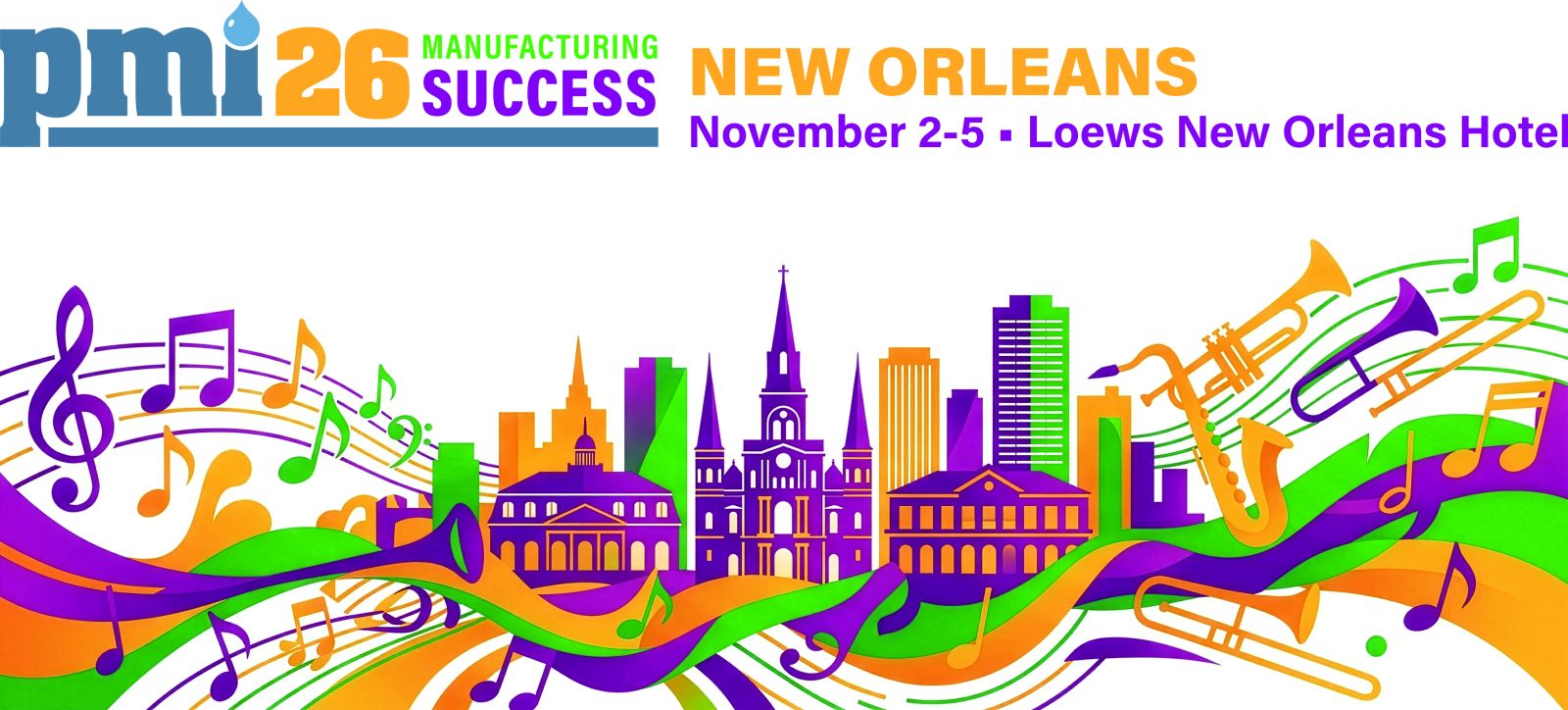
Registration will open soon for the PMI26 Manufacturing Success Conference, Nov. 2-5, in New Orleans. Inspirational new speakers continue to be added, including executive coach Erin Meadows, who will facilitate the PMI Inspiring Leaders Program, and Demo Diva founder and owner Simone Bruni, who will keynote the Women of PMI Breakfast.
Make a lasting community impact with a new sponsorship opportunity—one PMI member will support the painting of three rain barrels to be donated to local families in need. In addition, any employee of a PMI member company can nominate a deserving colleague this summer for the Paul Patton PMI Manufacturing Success Award—which grants complimentary PMI26 registration.
PMI Inspiring Leaders Program focuses on intentional leadership
Meadows will coach PMI Inspiring Leaders Program participants through a half-day, hands-on workshop to achieve “Leadership That Feels As Good As It Looks.”
Using her Legacy Mapping framework, Meadows will help attendees identify gaps in their leadership style through facilitated discussions, individual reflection exercises, and small-group conversation. Participants will develop their personal 30-day leadership action plans and gain practical tools for navigating leadership communication, visibility, connection, and time management.
Meadows, who describes her work as sitting “at the intersection of clarity, effectiveness and human sustainability,” brings 20 years of experience in senior leadership, marketing and communications to coach leaders on making changes that support long-term performance.
Women of PMI Breakfast: Building trust one pink demolition at a time
During the Women of PMI Breakfast, Bruni will share how community, consistency and tiny steps lead to real impact that endures.
When the PMI26 host city of New Orleans was devastated by Hurricane Katrina in 2005, Bruni took action. Despite having no background in construction or demolition, she was driven to help her neighbors begin the daunting process of restoring their hurricane-damaged homes. Armed with a $30 box of hot pink business cards, Bruni went door-to-door to help her neighbors recover.
Today, Demo Diva’s six hot pink excavators and 200 dumpsters are the calling card for redevelopment and new opportunities across Louisiana and the Gulf Coast, taking sites “down to the dirt” to prepare new chapters for her customers. For more than 20 years, Bruni has built a reputation for community involvement through trust, expanding her work in residential demolition to industrial and commercial projects.
Sponsor special rain barrel painting event to help local families manage stormwater
A new event sponsorship opportunity will allow one company to sponsor the painting of three rain barrels, which will be donated to local families in need. Hosted by Rain and Shine Barrels by Green Light New Orleans, the program will be open to any PMI members who would like to volunteer.
Because much of the city is below sea level and experiences about 62 inches of rainfall annually, flooding is a major concern. Green Light developed the program to provide residents with a low-cost tool to capture rainwater as a stormwater management solution. Rain barrels reduce runoff entering overburdened drainage infrastructure, alleviate local flooding, reduce land sinking (also known as subsidence), and allow residents to repurpose rainwater for non-potable uses.
Volunteers are critical to Green Light’s success. To date, more than 3,400 rain barrels have been prepared and painted by volunteers and installed throughout the city, reported Green Light’s website. The upcycled barrels come from food service partners.
Nominate a remarkable colleague for the Paul Patton Award
Do you have an admirable colleague who deserves recognition? Be sure to nominate them for the Paul Patton PMI Manufacturing Success Award.
The recipient will receive complimentary registration to the PMI26 Manufacturing Success Conference, including the PMI Inspiring Leaders Program and PMI Meeting of the Membership. The award honors an employee of a PMI member company who demonstrates exceptional leadership, teamwork, community involvement, and a bright future in plumbing manufacturing.
Named for former PMI Board of Directors President Paul Patton, the award celebrates Patton’s passion for mentoring young professionals and industry newcomers to become the next generation of outstanding industry leaders.
Any employee of a PMI-member company may nominate a fellow employee or team member for the award by completing a nomination form on the PMI website (https://tinyurl.com/2ztw4j3a). A PMI team will review nominations over the summer.
Elevate your profile among an audience that matters—with a sponsorship
Ready to elevate your profile among an audience that shapes industry decisions? Sponsor PMI26 to share your company’s latest innovations, build meaningful industry relationships, and demonstrate your organization’s commitment to advancing plumbing manufacturing at the highest level.
Join this intimate, members-only gathering of the most influential voices in plumbing manufacturing—where your ideas won’t just reach an audience. They’ll reach the decision-makers.
Become a part of PMI’s mission to actively advocate for products and technologies that meet the highest standards of safety, performance and water efficiency. All platinum, gold, and silver sponsorship levels put your company on the map, with your name and logo featured in conference materials, onsite signage, and video. Influencers and decision-makers will see your company’s name and logo showcased in PMI’s promo e-blasts, Ripple Effect, Inside My PMI, and social media posts.
Place your brand front and center by sponsoring morning and afternoon coffee breaks, conference registration, lunches, the PMI reception and dinner, or a keynote session featuring podium signage and the opportunity to introduce the speaker. Event sponsorships are limited to one sponsor only. Contact Jodi Stuhrberg, PMI director of programs and administration, to learn more.
Mid-Year Economic Outlook: Signs of Steady Growth

Connor Lokar
By Laura McGowan, PMI Communications Team, Valek and Co.
Geopolitical tensions, tariffs and global conflicts continue to create uncertainty; yet, many leading economic indicators remain surprisingly resilient—despite the headlines, reported ITR Economics senior forecaster Connor Lokar at the second quarter PMI Market Outlook LIVE. The housing market will likely stabilize even as consumers face affordability challenges, but inflation remains a concern for businesses, he added.
He noted that “the economy is growing” and despite unrest in the Middle East and rising oil prices, “from a macroeconomic standpoint, [this year will have] better growth rates than we’re ultimately going to see when we look to 2027.”
Housing: stabilization rather than acceleration
The housing market remains one of the economy’s most closely watched sectors, and the outlook suggests a period of stabilization rather than rapid growth.
Single-family housing continues to face headwinds, with building permits signaling near-term weakness, Lokar emphasized. Consumer expectations and affordability challenges persist. Home sales remain constrained by what Lokar referred to as “golden handcuffs”—homeowners holding onto low mortgage rates obtained in previous years.
However, there are reasons for cautious optimism. Mortgage payments have gradually begun to decline relative to income levels, and affordability is showing modest improvement. “The bad news is that the average mortgage payment is still almost double what it was six years ago,” Lokar stated. “While affordability is improving…homes are still not necessarily affordable to the millions of people who would like to purchase and ultimately move into a home.” ITR expects housing activity to stabilize in 2027 as these factors begin to improve.
Consumers remain a key economic driver
While consumer expectations may be at all-time lows, there is demand for materials and equipment for data center construction. Negative indicators such as credit card and auto loan delinquency rates, and declining savings rates are evidence of stress. Despite these stressors, “the U.S. consumer environment continues to expand,” Lokar shared.
Retail sales are improving, incomes are rising, and broad-based delinquency rates remain manageable.
A notable trend is the growing influence of higher-income households on overall consumer spending. As food, housing and healthcare costs consume a larger share of budgets for lower- and middle-income consumers, spending growth will increasingly depend on upper-income earners. As a result, plumbing manufacturers may want to prioritize high-end fixtures.
Observe data, not headlines
Increased oil prices will translate to higher global and domestic shipping costs, Lokar noted. U.S. gross domestic product is expected to increase through 2028, signaling that the broader economy will maintain its growth trajectory. Global industrial production is advancing, leading ITR to attribute its current economic indicators to signal an industrial growth cycle rather than an impending downturn, he emphasized.
Don’t ignore risks, though, Lokar advised. Geopolitical uncertainty, particularly surrounding international trade and energy markets, is likely to persist in the near term. While tariffs also continue to add inflationary pressure, he said ITR anticipates many tariff-related impacts will diminish as 2026 progresses.
Inflation is still a concern
Inflation remains a significant factor. While consumer prices for goods and services are showing momentum, producer prices are still rising across several key categories, including plumbing fixtures and construction-related materials, Lokar stated.
Government spending patterns also suggest continued inflationary pressures over the longer term. Combined with elevated energy prices and ongoing supply chain pressures, organizations should prepare to manage inflation as a critical strategic capability.
What leaders should do now
Lokar recommended that PMI members primarily focus on resilient markets and customer segments where demand remains strongest. By relying on data-driven decision-making, organizations will be better positioned to navigate uncertainty and capitalize on opportunities.
While challenges remain, growth is expected to continue, consumer fundamentals remain relatively strong, and opportunities exist for organizations willing to align their strategies with emerging market realities, he added.
PMI members can watch Lokar’s presentation on-demand and download his slides under PMI Market Outlook/Economic Reports at tinyurl.com/yhpbwxyy.
How Water Reuse Initiatives Could Reshape Manufacturing

By Judy Wohlt, PMI Communications Team, Valek and Co.
As droughts strain water supplies and large data centers consume millions of gallons daily, federal and state policymakers are advancing water reuse initiatives that could reshape water management practices for plumbing manufacturers and other industrial users. Several Plumbing Manufacturers International members have long embraced water reuse initiatives to stay ahead of emerging trends and advance sustainability goals.
The rapid expansion of data centers has intensified competition for water resources across the United States. Large facilities can use up to 5 million gallons of water each day—roughly the same amount consumed daily by a community of 10,000 to 50,000 residents, noted the Environmental and Energy Study Institute. As municipalities, agriculture and industry vie for limited water supplies, manufacturers face growing expectations to adopt water reuse strategies to improve water efficiency.
While the federal government currently supports water recycling through Environmental Protection Agency (EPA) guidance, several states—including Arizona, California, Colorado, Florida, Nevada, Texas and Virginia—have already enacted comprehensive water reuse and industrial wastewater recycling rules and programs. These policies are expected to expand as drought conditions persist and demand for data center capacity grows.
Federal lawmakers are exploring incentives to accelerate adoption. In May, Sens. Ben Ray Luján (D-New Mexico) and Katie Britt (R-Alabama) introduced the bipartisan “Advancing Water Reuse Act” (S4056). The legislation would establish a 30% investment tax credit for qualifying water reuse projects and encourage partnerships between manufacturers and municipal water recycling systems.
“Technology, specifically AI, has been moving so fast that municipalities and states haven’t had time to fully realize or plan for the huge water and energy demands these centers require,” said PMI technical director Kyle Thompson. “The reality of the high energy and water use is hitting home now, and states like California, Nevada and Virginia are ramping up water reuse plans. Plumbing manufacturers and other traditional manufacturers need to be prepared for getting wrapped up into the water reuse provisions that are being applied to data centers.”
EPA encourages water reuse with an updated plan
In April, the EPA released its Water Reuse Action Plan (WRAP) 2.0, which builds on the original 2020 plan’s mission to advance water reuse across the United States, with a focus on collaborative implementation, water security, sustainability, and resilience. PMI CEO/executive director Kerry Stackpole and PMI federal government affairs representative Stephanie Salmon attended the plan’s launch in Washington, D.C.
The updated plan is meant to “harness the power of water reuse for American industry, the artificial intelligence (AI) future, and American energy dominance while strengthening public health protections and safeguarding the nation’s water resources,” stated an EPA news release.
The EPA offers manufacturers and others a useful online tool, the Regulations and End-Use Specifications Explorer (REUSExplorer) (https://tinyurl.com/2vk9cp8a), which links to summaries of state water reuse regulations and guidelines.
PMI members reuse water for cooling, production washdown, and more
To support sustainability efforts, several PMI members have been implementing water reuse and recycling into their manufacturing processes for many years.
LIXIL has applied progressive water circulation, treatment, and recycling systems to reduce overall water intake and used about 630,000 cubic meters of recycled water in its operations during 2025, stated the company’s website.
Sloan’s Foundry employs evaporative condenser cooling towers that use recycled water, reclaiming about 18 million gallons of water annually. TOTO USA recycles post-industrial gray water for washdown during production, reducing potable water waste. TOTO USA’s website reported that the company recycles about 7 million gallons of water a year.
Gerber Plumbing Fixtures recycles and treats the wastewater from its labs and production processes while Kohler’s global operations reuse water in important ways. For example, Kohler’s faucet operations in Changzhou, China, installed a zero liquid discharge that allows the facility to recover 90% of wastewater for reuse in the plating process.
As drought, data center expansion, and evolving state and federal policies converge, plumbing and other manufacturers need to prepare for water reuse to continue shifting from a sustainability option to an operational imperative, Thompson emphasized.
Apply for PMI Leadership Position

What does it take to make a real difference in our industry? Leadership rarely emerges from comfort. It shows up when someone chooses to step forward—to contribute, collaborate, and serve something larger than themselves. That moment could be yours.
Why PMI leadership?
A Plumbing Manufacturers International leadership role isn’t just a line on your résumé. It’s a genuine career accelerator. Serving on the PMI Board of Directors or a committee gives you something increasingly rare in today’s business environment: the space to step back from the daily grind and engage in serious strategic thinking—alongside peers who are navigating the very same challenges you are.
Leaders at this level gain a broader view of what’s shaping our industry—from emerging technologies and market shifts to legislative developments and evolving stakeholder expectations. That perspective is hard to find anywhere else.
What’s in it for you?
- Share your expertise where it matters most
- Strengthen relationships with industry peers and influencers
- Sharpen your strategic thinking beyond day-to-day operations
- Develop and amplify your leadership voice
- Help shape the future direction of the profession
How to apply
Submit your committee or board leadership application at your earliest convenience. PMI’s 2027 leadership positions will be confirmed at the PMI26 Manufacturing Success Conference in November.
Leader is never a title someone gives you. It’s a decision you make—to engage, to contribute, and to make a difference. Now is your time.
Apply for the PMI Board of Directors: (https://tinyurl.com/mw3tyj9c)
Apply for a PMI committee co-chair position: (https://tinyurl.com/2ce7nxcn)