

March 2026
KBIS is the Super Bowl of Plumbing Innovation
 By Bob Neff, PMI Board of Directors President, Delta Faucet Company
Particularly for Plumbing Manufacturers International members who live in the North, attending the Kitchen and Bath Industry Show (KBIS) provides a break after a long winter. As the snow and ice melts and buds begin to appear, we can also see the green shoots of innovation each year at KBIS, which took place Feb. 17-19 in Orlando.
The brightest minds in plumbing manufacturing, distribution, and interior design convened to discuss the future of kitchen and bath products, shining a light on the road ahead while sharing skills and knowledge that will no doubt benefit humanity as a whole.
A meeting of minds
KBIS is a meeting of the minds dedicated to the improvement of integral home design where it truly counts. Innovators in charge of every square inch of the average homeowner’s bathroom and kitchen space shared both a roof and pioneering ideas with one another over the course of three days. With more than 650 brands taking over almost 500,000 square feet of space inside the Orange County Convention Center, KBIS presented dynamic and immersive presentations via booths and panels, displaying and discussing leading-edge technology aiming to elevate the experience of the average user.
Past standouts, future home necessities
We again saw our fair share of incredible inventions gracing the convention center. Standouts include toilets that analyze their contents for health concerns using AI technology, features that allow the user to troubleshoot and request maintenance for their kitchen appliances with their phone, and innovative product designs in kitchen and bath faucets. KBIS is not just a watering hole for like-minded innovators—it’s where progress can truly hit the ground running.
Where design meets inspiration
Of course, KBIS is not only concerned about the products already on display and in our homes, but the prototypes still in their infancy, as well. Events such as the Innovation Hour provided brands the space to present their designs to an audience that decided upon three awards: “most innovative,” “most unexpected,” and “I’d spec that tomorrow.”
On an even greater scale, awards were given out to finalists handpicked by the conference’s esteemed judges during the Best of KBIS Awards ceremony. For more on which PMI members won Best of KBIS Awards, as well as the finalists, see the story on page 5.
Attendees describe their time at the conference as vibrant, electric, and full of energy, invigorating minds and spirits with new ideas that push the envelope of what is possible. PMI’s Power Break and Briefing enabled PMI members to learn the latest about their association’s advocacy and government affairs efforts.
Looking to the future
While KBIS came to an end, PMI’s mission of innovation, ease of access, and water conservation through improvements in plumbing technology will never cease. PMI’s members are endlessly grateful for the countless individuals who share our goal and who attended KBIS, and I am looking forward to learning more about the advancements and new ideas that were highlighted this year.
Leading Through Intelligent Disruption
 By Kerry Stackpole, IOM, FASAE, CAE, PMI CEO/Executive Director
Our industry has always balanced durability with innovation. Today, however, the pace and scope of change are unprecedented. Gen. Eric Shinseki, the first Asian-American four-star U.S. Army general, once remarked, “If you don’t like change, you’re going to like irrelevance even less.” Today, artificial intelligence, digitized supply chains, workforce redefinition, ESG pressures, and geopolitical volatility are converging simultaneously. For leaders of family-held and public companies alike, avoiding irrelevance by incremental adaptation is no longer sufficient. What is required is disciplined, forward-leaning leadership grounded in strategic clarity and operational precision. In this era of intelligent disruption, leaders bring focus to the today and what lies over the horizon.
AI is no longer an experiment or a peripheral technology initiative—it is rapidly becoming core industrial infrastructure. In plumbing manufacturing, AI applications extend well beyond factory robots, chatbots, or back-office automation. Predictive maintenance, yield optimization, automated quality inspection, demand forecasting, dynamic pricing, and generative product design are already delivering measurable returns. Leaders must shift from asking, “Should we use AI?” to “Where does AI materially improve throughput, cost structure, or customer responsiveness?”
AI and automation will not eliminate manufacturing jobs—but they will fundamentally reshape them. The future workforce in plumbing manufacturing will be hybrid: part mechanical, part digital, part analytical. Make no mistake, there must be upskilling. Maintenance technicians must learn to interpret predictive analytics. Production supervisors must understand data dashboards. Engineers must work alongside generative design tools. The competitive advantage will lie in how effectively companies integrate human judgment with algorithmic insights. AI can optimize schedules; it cannot replace frontline intuition about performance anomalies.
Younger workers increasingly seek purpose-driven, technologically sophisticated workplaces. Companies that position themselves as advanced manufacturers—not legacy industrial firms—will attract higher-quality talent. The “future of work” in this sector is not remote factories—it is smart factories requiring higher cognitive engagement. Leaders must invest accordingly.
Looking ahead, strengthening supply chain resilience will remain an essential component of success. Global volatility—trade disputes, shipping disruptions, raw material fluctuations—all remain a structural reality. Brass, steel, resins, rare earth minerals, and electronic components all carry geopolitical risk. AI-driven supply chain visibility tools can simulate risk scenarios, optimize inventory positioning, and identify secondary suppliers proactively. However, resilience is not purely technological. Leaders must balance efficiency with redundancy. While building that resilience may mean strategic dual sourcing in critical components, nearshoring, or building collaborative forecasting relationships with distributors and wholesalers, it’s most likely everything, all at once. In uncertain times, just-in-time thinking must be recalibrated toward just-in-case preparedness—without eroding margins. That requires fresh analytical rigor.
One of our industry’s greatest strengths is our long-term commitment to innovating for sustainability without sacrificing performance, the end-user experience, and overall satisfaction with our products. Water efficiency, material sustainability, and carbon reduction are no longer peripheral regulatory issues. They are central to brand equity, especially in public procurement and large commercial projects. AI can accelerate eco-design by modeling water flow optimization, material performance, and lifecycle durability before tooling begins. Strategies to integrate sustainability metrics into product development dashboards and quantify environmental performance will be a competitive differentiator. The need to communicate credible ESG narratives backed by data—not marketing claims—will continue to positively influence the marketplace. For family enterprises, this often aligns naturally with generational stewardship values. For public companies, it strengthens investor confidence and risk management.
Uncertainty tempts all of us to move toward reactive decision-making—chasing short-term volume, cutting innovation budgets, or diversifying without coherence. The exact opposite discipline is what’s required. As a leader you must clearly define the core product categories where your company holds structural advantage. Working to target the best customer segments (builder-grade, luxury, commercial, institutional) for your products and driving the innovation cadence and margin expectations for your firm are vital. Companies that lack clear positioning will struggle to deploy and execute effectively. There’s little worse than discovering you have executed the wrong strategy brilliantly.
Finally, leadership itself must evolve. You already understand the traditional command-and-control manufacturing model is insufficient in a data-rich, rapidly changing environment. Demanding data-driven decision-making while leaving room for experimentation remains a competitive edge. Being transparent about technological transitions and the trade-offs between short-term earnings pressure and long-term competitiveness will help your teams adapt. In family-held companies, this often means professionalizing governance while preserving entrepreneurial agility. In public firms, it means resisting quarterly myopia in favor of durable transformation.
The plumbing fixture and fittings manufacturing industry is not immune to technological and cultural disruption—we are entering a new industrial chapter. Leaders who treat AI as infrastructure, redesign work intelligently, build resilient supply chains, integrate sustainability rigorously, and sharpen strategic identity will define the next decade. Uncertainty is not a temporary condition; it is our operating environment. The competitive advantage will belong to leaders who are precise in strategy, disciplined in execution, and bold in reimagining how intelligent manufacturing creates value.
PMI Ambassadors Convey Vital Communications
 By Judy Wohlt, PMI Communications Team, Valek and Co.
Plumbing Manufacturers International ambassadors play an essential role in sharing information from PMI within their companies and across the industry. These employees of PMI member companies alert colleagues to timely legislative issues, spread the word about PMI programs and webinars, and encourage coworkers to get involved in PMI committees and working groups.
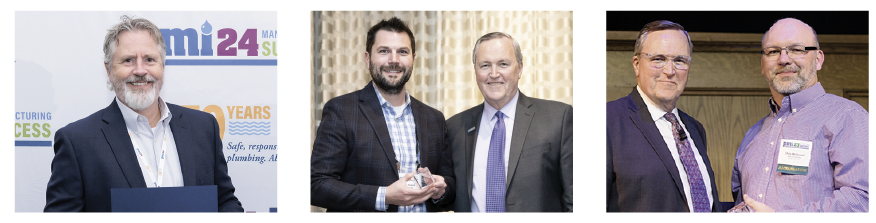
“They become a conduit to information,” noted Jodi Stuhrberg, PMI director of programs and administration. Every PMI member company designates an ambassador who promotes PMI’s mission and resources internally and among industry professionals, while serving as a trusted point of contact to coordinate and support PMI-related requests and action items. “These individuals are passionate about our industry, and we’re grateful for their wonderful work,” she added.
PMI equips ambassadors with a welcome package and other tools that help colleagues access PMI member benefits, learn about association communications and committee participation, and know where to follow PMI on social media, Stuhrberg emphasized.
Lars Christensen remains a longstanding champion
Presented with the PMI Ambassador Award in 2024, Lars Christensen, vice president of product strategy and market intelligence for BLANCO, considered himself a PMI ambassador long before the program became official in 2019. Since 2002, “I have always promoted PMI at anytime and anywhere possible,” he shared.
Christensen’s commitment runs deep. He hasn’t missed more than two PMI Manufacturing Success Conferences in 25 years and always looks forward to attending, he stated. Throughout BLANCO, he shares PMI market data, legislative updates, and the latest information on PFAS and other water-related issues. He distributes relevant data to the company’s internal sales and marketing teams via a monthly newsletter, ensuring decision-makers stay informed and proactive.
By consistently circulating insights and reinforcing PMI’s value, Christensen has embedded association engagement into the rhythm of his company’s operations.
Role becomes a natural fit for Dan Rieland
For Dan Rieland, manager of codes and standards at Kohler, becoming an ambassador was a natural fit, noting the strong alignment between compliance professionals and trade associations.
Rieland, the 2025 PMI Ambassador Award recipient, takes every opportunity to raise awareness about PMI’s resources and demonstrates how colleagues can extract value from membership benefits. Whether directing coworkers to self-service tools on PMI’s website, flagging regulations that require deeper understanding, or encouraging participation in webinars and committee calls, he uses PMI content as a springboard for action.
Sometimes that means rallying attendance for an upcoming event. Other times, it involves digging into complex regulations, confirming Kohler’s organizational position, or ensuring feedback flows back to PMI. “Trade or industry associations are one of those things where you get out of it many more times what you put into it,” Rieland emphasized. “PMI continues to be the gold standard of what great value can look like through these memberships.” He views his ambassador role—and time spent engaged with PMI committees—as a stepping stone toward other leadership opportunities within the association, he stated.
Chris McDonald sharpens his networking skills
Chris McDonald’s path to ambassadorship evolved alongside his expanding responsibilities in product compliance. By 2020, McDonald became the primary technical contact between Moen, Fortune Brands Innovations, and PMI, he noted. Becoming an ambassador sharpened his communication and networking skills, too, he added.
McDonald, former principal compliance engineer at Moen, reached out to technical teams and business leaders, detailing how Moen engaged with PMI and how colleagues could get involved. His efforts led associates to sign up for PMI’s newsletter, access member privileges, and attend committee calls, he emphasized.
Receiving the PMI Ambassador Award in 2023 came as a surprise. “I didn’t know that I would even be eligible for, let alone receive such an award,” he stated. As he begins a new role at another company, McDonald said he plans to continue sharing the value and benefits PMI delivers to the industry.
In addition to ambassadorships, PMI members can engage with the association by serving as a committee co-chair or becoming a board member. “Members can dip their toe into engagement by joining a committee to see how they work, too,” Stuhrberg encouraged.
Power Break Delivers Lively Exchange On Legislative Issues
 By Judy Wohlt, PMI Communications Team, Valek and Co.
The PMI Power Break and Briefing at this year’s KBIS delivered a lively question-and-answer session with PMI members. The briefing focused on several federal and state legislative issues, including trade and tariffs, water efficiency efforts in California, extended producer responsibility (EPR) for packaging laws, and reporting on per- and polyfluoroalkyl substances (PFAS).
“Our advocacy flows from member priorities, so we always appreciate when they stay engaged and share their views in forums like this,” noted Matthew Windrum, PMI director of state government affairs, policy and advocacy.
He provided an update on the most comprehensive state bans on the sale of consumer products containing PFAS, which are currently undergoing implementation in Maine, Minnesota and New Mexico, as well as additional proposals for comprehensive or partial bans in states across the country. PMI’s efforts focus on ensuring state officials understand the potential practical impacts of such laws, and that any new laws related to PFAS bans should be clear, science-based, and implementable. States need to give manufacturers adequate time to adapt as well, he added. Windrum shared that he and PMI’s Technical Director Kyle Thompson planned to testify in New Mexico at the end of February on the state’s PFAS Protection Act (HB 212) and the New Mexico Environment Department’s proposed rules under the law.
EPR packaging laws remain on PMI’s radar. Windrum said he anticipates interest in additional state EPR laws to intensify and that PMI members should remain abreast of timelines, reporting deadlines and other compliance requirements. In states that are considering implementing their own EPR laws, Windrum said that “PMI will continue to advocate for practical, implementable, science-based programs that are developed in the spirit of genuine collaboration with producers, and, wherever possible, are aligned with EPR laws across other states.” He recently joined the American Institute for Packaging and the Environment’s (AMERIPEN) fly-in to Albany, New York, to discuss the issue with stakeholders there.
Windrum discussed PMI’s efforts to support the growth of the housing supply through building conversions, permitting and zoning rule modifications, and other methods. He also provided updates on water-efficiency standards; point-of-use filtration for drinking water; and skilled trades workforce development.
California’s continued focus on PFAS, climate reporting, water efficiency, and data centers
PMI’s California government affairs consultant Jerry Desmond provided an overview of key policy areas for PMI. He discussed the state’s proposal to lower the current 1.28 gallons per flush (gpf) maximum flow rates for water closets in appliance efficiency regulations and potentially in building codes.
Desmond also shared updates on tensions between the state’s continued interest in driving water efficiency and corporations’ ambitious plans to build data centers that will ramp up demand for electricity and water. He noted anticipating another year of high-level interest in identifying and eliminating PFAS in consumer products and waste streams.
He reminded the large group of attendees to prepare for the eventual implementation of corporate climate reporting obligations if they conduct any business in California. Companies that earn annual global revenues exceeding $1 billion will be required to report on Scope 1, 2 and 3 greenhouse gas emissions, and those earning $500 million will trigger corporate climate financial risk disclosures, Desmond emphasized.
Tariffs, DOE rulemakings on faucets, and housing affordability remain concerns
PMI’s federal government affairs consultant Stephanie Salmon provided an update on how tariffs, deregulatory actions, and issues with housing affordability are impacting plumbing manufacturers and related trades.
Uncertainty remains over United States trade policy—particularly any remaining or impending tariffs, trade agreements, and the first mandatory review of the U.S.–Mexico–Canada Agreement (USMCA) and on how that review will be managed. “Plumbing manufacturers and their suppliers rely on stability to plan investments, grow operations, and create jobs,” Salmon noted. PMI continues to urge the Trump administration to reduce trade uncertainty and exempt tariffs on industrial materials not made in the U.S.
As part of the administration’s announced commitment to “slash unnecessary red tape and regulations,” the Department of Energy (DOE) has proposed several deregulatory actions that, if successful, will significantly scale back the department’s Appliance and Equipment Standards Program, Salmon noted. In May 2025, DOE published dozens of proposed rules that would rescind existing test procedures and make changes to energy and water conservation standards, particularly for faucets and pre-rinse spray valves. PMI has submitted comments to the DOE and met with agency officials to express concern over the proposed rule for rescinding the current water use standards for faucets, she added.
To address the housing affordability challenge—which has been exacerbated by supply chain bottlenecks and a shortage of skilled labor—PMI supports bipartisan housing reform legislation, Salmon reported. The two proposed bills, Housing in the 21st Century Act (HR 6644) and ROAD to Housing Act of 2025 (S 2651) would make it easier to build new housing, expand financing options, and enhance program oversight and coordination, she emphasized.
Desmond and Salmon also participated in PMI member TOTO’s panel discussion on the 2026 Plumbing Industry State of the Union. Moderated by TOTO’s Fernando Fernandez, the panel focused on the future of bathroom design, sustainability, wellness, and technology.
PMI Team Connects With Members and Their Innovations at KBIS
 By Judy Wohlt, PMI Communications Team, Valek and Co.
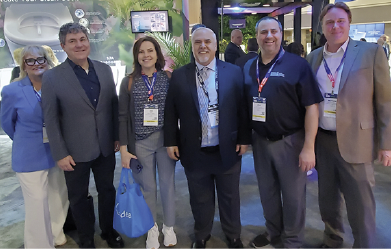
At the recent Kitchen & Bath Industry Show (KBIS), the Plumbing Manufacturers International team connected with members and interacted with their product innovations, some of which won awards and recognition.
Several PMI members earned recognition for their innovative, stylish and sustainable bath and kitchen products. Kohler won “Best in Show” for its Kohler x Studio McGee Claude Bathroom Collection and the “Most Functional Find” Silver Award for its PureWash E860 Bidet Toilet Seat. TOTO received “Best in Show” for its Auroratm Washlet + S7A One-Piece Toilet, and Pfister Faucets earned the “Style Statement: Bathroom” Silver Award for its Ametrine Faucet Collection.
Delta Faucet Company, Kohler and Moen were finalists in the Best of KBIS “Style Statement: Bathroom” category. Finalists in the “Style Statement: Kitchen” category included Kohler and Zurn Elkay Water Solutions, while Kohler and Delta Faucet were finalists in the “Game Changing Innovation” category. In the “Most Functional Find” category, Kohler and Moen placed as finalists. Kohler and Zurn Elkay were finalists in both the “Sustainable Standout” and “Wellness Trailblazer” categories.
During the three-day event in Orlando, Florida, the PMI team explored the 500,000-square-foot space where PMI members displayed their most innovative and sustainable products. The immersive event brought together 650 exhibitors showcasing the latest products, trends, and technologies for design, remodeling, and plumbing industry professionals.
“It was a pleasure to see so many PMI members exhibiting at KBIS. PMI staff values this in-person, one-on-one experience with our members as they proudly displayed their innovative and stylish products, which focused on sustainability and compliance,” emphasized Jodi Stuhrberg, PMI director of programs and administration.
In addition, Dean Camastro, Northeast regional sales manager for PMI member Duravit, spoke on “Building Tomorrow: Integrating Sustainability into Every Layer of the Built Environment” as part of the KBIS Voices from the Industry program. Camastro was one of more than 65 speakers who provided fresh insights and sparked new ideas to shape the future of kitchen and bath design, reported the KBIS website.
Storehouse Project Awards spotlight building industry’s generosity
Along with PMI members Gerber, Kohler, and Reliance Worldwide Corporation, PMI co-sponsored World Vision’s Storehouse Project Awards Breakfast, held at KBIS to support the Storehouse of World Vision. The storehouse provides building materials to individuals in need and organizations that support them.
This year’s event featured a video showing how donated storehouse building materials, including bathroom and kitchen fixtures, helped rebuild more than 400 homes impacted by Hurricane Helene—particularly in North Carolina.
Ruth Mitchell, editor of The Wholesaler magazine (to which PMI regularly contributes articles), is serving on the 2026 Storehouse Project Executive Committee.
PMI Study Adds New Economic Impact Data for Plumbers
 By Judy Wohlt, PMI Communications Team, Valek and Co.
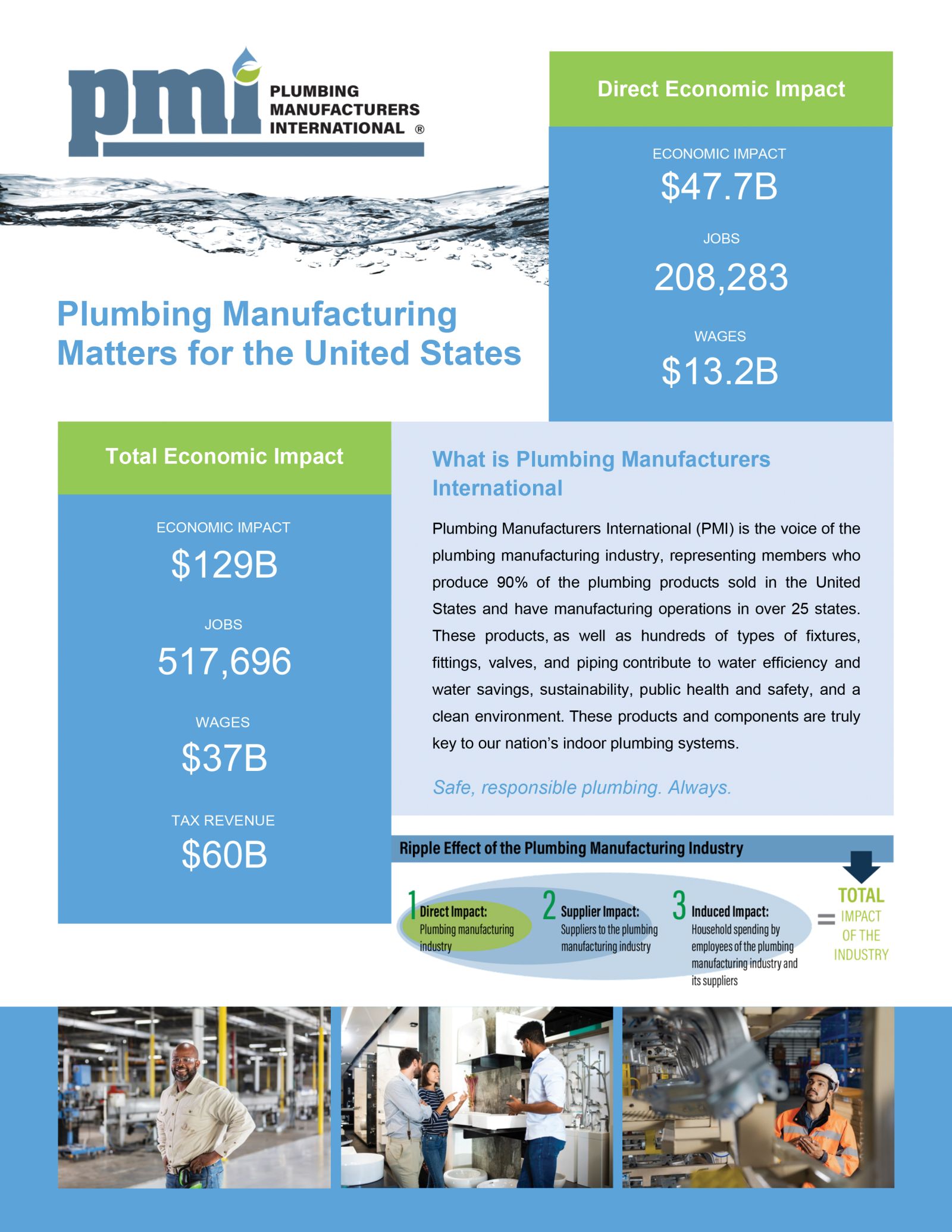
Plumbing Manufacturers International recently commissioned a study that delivers new economic impact data relating to plumbers—revealing the powerful financial force plumbing manufacturers and plumbers drive across the American economy.
In 2025, this combined economic force totaled more than $442 billion, almost 1.8 billion jobs, and over $142 billion in wages, reports the updated Plumbing Manufacturing Industry Economic Impact Study. Plumbing manufacturers, along with their wholesale and retail partners and suppliers, contributed $129 billion, more than 500,000 jobs and $37 billion in wages. Together, both industries generated almost $60 billion in tax revenue.
While the economic impact is substantial, a shortage of more than 500,000 plumbers in the United States remains—and is costing the economy $38 billion annually, reported a study commissioned by PMI member LIXIL. Generated by research firm John Dunham & Associates, the LIXIL report quantifies how the plumber shortage is driving up costs for builders and others, delaying project timelines, and straining industries across the economy.
Filling the plumbing workforce gap will require revitalized vocational education programs, increased apprenticeships, and further collaboration between the plumbing industry, policymakers and educators.
The PMI Board of Directors committed to investing in the study to complement LIXIL’s report, “Blocked Pipes: The Economic Consequence of Skilled Worker Shortages,” (tinyurl.com/bdhx66kc) to guide PMI’s workforce development and advocacy strategies. PMI commissioned John Dunham & Associates to update the association’s 2023 study to include data on jobs and wages directly provided by plumbers.
Data demonstrates symbiotic relationship between plumbing manufacturers and plumbers
“These economic impact data illustrate the vital symbiotic relationship between plumbing manufacturers and plumbers,” noted PMI CEO/Executive Director Kerry Stackpole. “Our combined industries generate good-paying jobs, opportunities to learn in-demand technical skills, and a tax base that funds schools, infrastructure, and other public services.”
An expanded plumbing workforce supports faster housing delivery, more efficient water use, and safer buildings, Stackpole emphasized. It creates upwardly mobile career paths that don’t involve excessive student debt. It strengthens domestic manufacturing by ensuring that innovative, high-performing products can be properly installed and maintained, he noted. Most importantly, it reinforces the systems that Americans rely on every day for safe, clean water.
PMI will soon update the economic impact page (safeplumbing.org/advocacy/economic-impact) on its website with the new study data. PMI members, policymakers and others can view the data via a web-based tool that generates both plumbing manufacturing industry and plumbing industry economic data tables and reports. The reports can be tailored to show national data or data by state, congressional district, state house district, or state senate district.
Economist Offers Modest Optimism for 2026
 By Laura McGowan, PMI Communications Team, Valek and Co.
Connor Lokar of ITR Economics offered modest optimism on the economic indicators impacting manufacturing and housing demand in his recent PMI Market Outlook LIVE presentation.
Lokar emphasized that the U.S. economy will likely continue to expand through 2026, but growth may be uneven. “The economy is in relatively good shape,” he said. “We are seeing sluggish but consistent business cycle improvement. Consumer finances are in relatively good shape overall.” Lokar added that uncertainty sparked by tariffs appears to be diminishing.
Manufacturing and industrial production are beginning to rebound
U.S. industrial production and manufacturing volumes have crossed to the positive side, signaling improved baseline demand and healthier wholesale activity. “What we see now is growth coming back to parts of the economy that didn’t really get to participate to any great extent in the GDP-defined growth we saw in 2023-2025,” Lokar explained.
Consumer spending has stabilized, but housing is still a challenge
Increased consumer spending—up 1.1% when adjusted for inflation—means better news for the housing market, he shared. “A lot of folks don’t feel great about the economy and haven’t for several years. But at least for 2026, we don’t see the consumer as being the undoing of the economy,” he added.
Single-family housing starts for 2026 are down 6.6%, significantly underperforming forecasts. “In the fourth quarter [of 2025]…housing starts were down 14.4% from the fourth quarter of 2024,” Lokar emphasized. “There are too many new homes out there relative to the underlying home sales trend.”
Affordability remains the key underlying issue for many buyers, with “massive disparities” between income levels and the average priced homes in many states, he noted. High mortgage rates and an oversupply of new construction homes are resulting in a softer market, with weak permits and builder sentiment across much of the United States. “It’s going to take largely the balance of 2026 for that to normalize,” Lokar stated.
Lokar shared some positive news: home loan delinquency levels are “low and stable,” which means that people are making payments on time on existing mortgage loans.
Recovery for the plumbing industry
Domestic plumbing fixture production in the U.S. continues to recover, up 0.4%, he shared. “We’re starting to see the very slightest signs of life,” said Lokar, who noted that the volume relationship between existing home sales and plumbing fixture production offers a strong correlation for growth, as home remodeling “should be stable if not slightly biased to the upside.”
Lokar reported a “rising tide” in the physical goods economy, citing overall acceleration in both industrial production and manufacturing volumes.
Other segments are showing potential for increased demand. “We do see some growth in the multifamily market trend…up double digits at 11.2%,” he stated. “Multifamily dwellings, lots of bathrooms, lots of kitchens.”
‘Profitless prosperity’ risk remains
The cost of doing business continues to rise, with increased electricity use from an explosion of data center demand, labor shortages, transportation costs, and tariffs, he emphasized. A significant federal deficit has resulted in higher interest rates and inflation. Manufacturer volumes may trend upward, but profit margins will be narrower. “Top line is up, volume is grinding up, but we’re still struggling on the profit side of things, and we’re not able to reprice our revenue or eliminate costs quickly,” Lokar stated. “That’s one of the more sinister challenges that is not going to go away.”
Keeping an eye on the Fed chair
With the nomination of Kevin Warsh as the next chairman of the Federal Reserve, Lokar noted that the Fed’s ability to act independently could send ripple effects across the economy. An aggressive interest rate cut could have a volatile impact on the bond markets and result in higher mortgage interest rates. “Just because the Fed cuts interest rates doesn’t mean that mortgage rates are going down,” Lokar emphasized.
PMI members can watch Lokar’s presentation on-demand and download his slides under PMI Market Outlook/Economic Reports at tinyurl.com/yhpbwxyy.