

May 2026
It’s Spring—And Bills Are Popping Up All Over
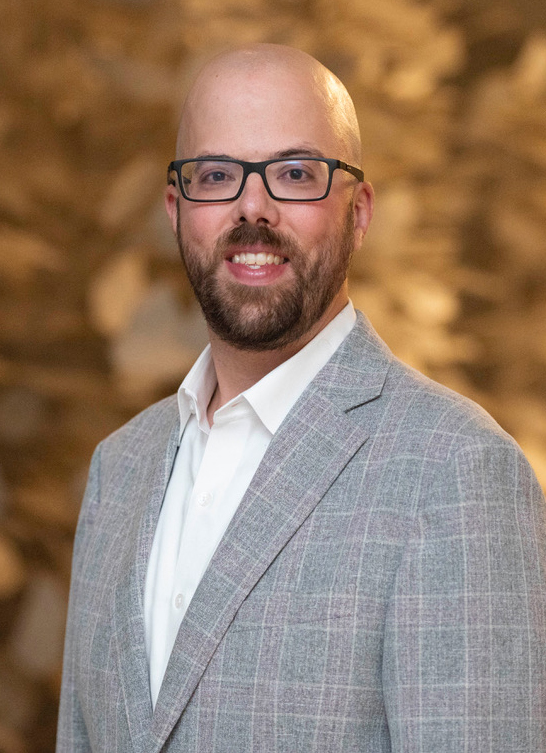 By Bob Neff, PMI Board of Directors President, Delta Faucet Company
Spring is here and, along with the flowers and buds, bills are popping up all over the nation. According to a recent PMI Legislative Tracking Report, more than 70 bills in 26 states have been introduced or moved forward in the past two weeks alone. As plumbing products become more technologically sophisticated, sustainability becomes the new normal, and the need for skilled trades workers expands, the number of bills pertinent to our membership has increased substantially.
The need to more closely monitor and influence state legislation and regulation brought Matthew Windrum on board early in 2025. As PMI’s director of state government affairs, policy and advocacy, Matthew provides our team with an experienced set of eyes to track bills, as well as a personal presence at state capitals and legislative conferences. On a mission to keep legislation and regulation balanced, science-based and implementable, he builds upon the trustworthiness of PMI’s brand.
PMI expands its presence among policymakers
PMI now has a presence at the meetings of major state policymaking organizations including the American Legislative Exchange Council, AMERIPEN Annual Summit, Council of State Governments, National Conference of State Legislatures, and National Governors Association, as well as at various state chambers of commerce and manufacturing-related fly-ins and conferences. These venues allow for interpersonal contact with officials across the nation in a time- and cost-efficient manner.
PMI is also strengthening relationships with kindred trade associations in the plumbing, manufacturing and water sectors. These ties help these associations to inform each other of early-warning situations and to bring additional advocacy efforts to a particular bill or issue.
Among the particularly active issues right now are extended producer responsibility (EPR) for packaging, PFAS in products or water, point-of-use water filtration, and skilled trades workforce development. The PMI team engages during both the legislative and rule-making processes; the team also monitors any lawsuits or aftermath that follow implementation of the laws. The tariff situation is a good example of that, as PMI advocated against tariffs, tracked how to gain exemptions or comply after they were implemented, and now is monitoring legal actions concerning refunds.
Member involvement makes PMI more effective
All PMI advocacy/government affairs work becomes more effective with member involvement, particularly in states where members have facilities and employees. It helps to have members on the ground and on call when state legislation or regulation are in play. Involvement means staying engaged, sharing opinions, and joining working groups such as the new EPR group. These forums provide a way for PMI members to come to agreement on policy positions and on how to best make our case to officials. PMI staff is also willing to organize calls with members who are concerned about the plumber shortage or other skilled trades workforce development issues.
Staying engaged in advocacy/government affairs places a special emphasis on the idea that we’re all in this together, especially when advocating for safe, responsible plumbing—always—and for our Rethink Water goal of ensuring that future generations have reliable access to clean and safe water. We all must give voice to these aspirations.
With spring in the air, take a close look at bills we’re following by reviewing the latest PMI Advocacy/Government Affairs Committee report (tinyurl.com/r33en9tr), which is organized according to federal and state bills. Which ones affect the state where your company is located? Which ones motivate your personal involvement? We’d love to have you participate in the next committee meeting.
Leading As the Real You
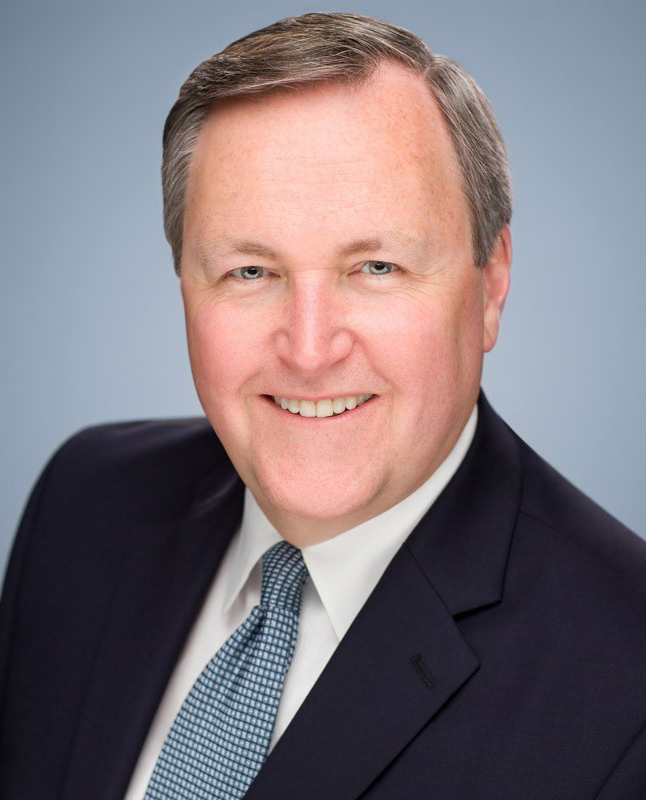 By Kerry Stackpole, IOM, FASAE, CAE, PMI CEO/Executive Director
There are moments—often unplanned—when something from much earlier in life resurfaces with unusual clarity. A smell, a place, a fragment of conversation. And with it comes a version of yourself that predates the accumulated layers: the titles, the responsibilities, the expectations, the habits of performance. For a brief instant, all of that recedes.
What remains is not the executive, the strategist, or the public-facing leader. It is something simpler. Less constructed. More grounded—and often more honest. For CEOs and other leaders, this distinction is not philosophical; it is operational. Because the further one progresses in leadership, the easier it becomes to conflate what you do with who you are.
Leadership at the executive level is an exercise in accumulation. Over time, you acquire authority, visibility, influence, obligations—and a narrative about yourself. You also accumulate expectations. Stakeholders expect decisiveness. Employees expect clarity. Boards expect performance. Markets expect consistency. Eventually, you expect all of this from yourself, always.
Breaking out of your professional shell
To function under these conditions, many leaders develop a professional shell. It is not inauthentic; it is adaptive. It allows you to operate at scale, make decisions quickly, and absorb pressure. But there is a cost. Over time, the shell becomes indistinguishable from identity. The role stops being something you inhabit and becomes something you believe you are.
When identity is tightly bound to role, every challenge becomes existential. A strategic misstep feels personal. A downturn feels like a referendum on your competence. Internal dissent feels like disloyalty rather than data. This is not only psychologically taxing—it is operationally dangerous. It narrows perception, reduces your ability to process disconfirming information, and encourages defensiveness when adaptability is required.
If leadership is anchored in what you do, your tools will be structural: directives, processes, controls. If it is anchored in who you are, your influence operates differently. It becomes relational, contextual and durable.
Defining reality and saying thank you
At the CEO level, the job is not execution. It is the distribution of clarity and the transfer of ownership. As Max De Pree, the former CEO of Herman Miller once observed, “The first responsibility of a leader is to define reality. The last is to say thank you.” In between, leaders must ensure people understand what matters, why it matters, and how their work connects to outcomes. That requires more than directives. It requires consistency between words, actions and priorities.
There is also a structural risk unique to CEOs: distance. You are insulated by design. Information is filtered. Feedback is softened. Over time, a gap emerges between perception and reality. If your identity is tied to your role, you are more likely to accept that gap. If it is not, you are more likely to challenge it—seeking unfiltered input, tolerating discomfort, and prioritizing accuracy over validation. That is not philosophical. It is a competitive advantage.
The practical question is not whether leaders can shed their roles—they cannot. The question is whether one can periodically strip away the accumulated layers without losing effectiveness. This requires deliberate practices: engaging in conversations where you are not the decision-maker, revisiting first principles, and inviting unfiltered feedback for calibration. These are not indulgences. They are mechanisms for clarity.
Those moments when the past surfaces are not distractions. They are signals. They remind you that before the role, there was a person—and that person is often better equipped to lead than the version optimized for performance. Because leadership is not about asserting control. It is about creating the conditions for others to perform at their best. That is achieved not through directives alone, but through clarity, consistency and credibility.
And those depend less on what you do—and more on who you are.
California Eyes Stricter Water-Efficiency Rules
By Judy Wohlt, PMI Communications Team, Valek and Co.
As California considers stricter water-efficiency rules for toilets and building standards aimed at reducing potable water use, Plumbing Manufacturers International is actively providing feedback and technical expertise to the state. The California Department of Water Resources is not discounting the possibility of a drought, which could accelerate the state’s rulemaking, noted PMI Technical Director Kyle Thompson.
PMI submitted comments to the California Energy Commission (CEC) in late April, urging the state to align with nationally recognized requirements such as WaterSense specifications, avoid California-only product mandates, and consider the broader system impacts of reducing indoor water flows, Thompson explained.
PMI has also been weighing in on regulations being developed under the Drought-Resistant Buildings Act (SB 745). PMI met with California Building Standards Commission (CBSC) officials to share PMI’s expertise on the potential consequences of reducing water use.
PMI responds to CEC pre-rulemaking on water closets
The CEC is in the pre-rulemaking phase for water closets and is considering updates to efficiency standards, test procedures, markings, and certification requirements under Docket 22-AAER-05. The agency issued a Request for Information (RFI) in March, and PMI will respond in early May.
“PMI appreciates that the CEC’s latest RFI reflects a more measured approach, including recognition that very low reduced-flush volumes can approach best-available-technology thresholds and that further reductions in single-flush volumes may raise unresolved concerns for wastewater infrastructure, drainline carry, and existing plumbing systems,” stated PMI’s comments.
The docket’s draft proposals, aimed at increasing water and energy savings, include several options, such as mandatory dual-flush toilets. The RFI also proposes reducing maximum flush volumes to 1.1 gallons per flush (gpf) for single-flush toilets and 1.28/0.9 gpf for dual-flush models. PMI recommends keeping the maximum reduced flush volume for dual-flush toilets at 1.1 gpf—not 0.9 gpf—to align with existing universally recognized requirements.
PMI opposes the state’s proposed three- to 10-year timeline to reduce the maximum flush volume for single-flush toilets from 1.28 gpf to 1.1 gpf. PMI believes the state should evaluate the cumulative effects of CEC’s 2015 Title 20 appliance efficiency rulemaking and how the installation of high-efficiency plumbing fixtures and fittings will impact California’s drinking-water systems, building plumbing, wastewater conveyance and treatment, and recycled-water production.
The association also urged the CEC to maintain a performance-based market rather than mandate dual-flush designs. PMI contends that a mandate would limit consumer choice, restrict design flexibility, and push manufacturers toward a narrow California-only product focus without proving true efficiency or cost-effective water savings beyond standard product replacement.
“If the CEC wishes to encourage dual-flush adoption, it should do so through voluntary programs, incentives, consumer education, and harmonization with nationally recognized specifications rather than through a mandatory design requirement,” PMI stated.
PMI further emphasized that utilities and wastewater stakeholders have documented that declining flows can increase water age and reduce disinfectant residual in drinking-water systems, while also reducing recycled-water production and increasing solids accumulation, odors, corrosion, and treatment challenges in wastewater systems.
To address these concerns, PMI recommends that the CEC prioritize replacing legacy products, offering targeted incentives, and conducting field research before pursuing further flush-volume reductions.
Drought-resistant building standards advance
California is also developing building standards under the Drought-Resistant Buildings Act, aiming to reduce potable water use through CalGreen updates to the 2027 Triennial Code Adoption Cycle.
In March, PMI members met with CBSC Deputy Executive Director Kevin Day to discuss implementation. Day emphasized the urgency of addressing PMI members’ concerns about reducing potable water use, Thompson said.
The CBSC has asked PMI to provide input on premise plumbing pathogen risks, including the potential for reduced water use to increase stagnation, extend water age, and lower chlorine residuals in building piping systems.
Current draft concepts include a proposal to mandate non-water urinals as a compliance option in certain non-residential applications—an issue of particular concern to PMI members that manufacture non-water or hybrid urinals.
PMI will continue to monitor the rulemaking process, especially for its potential ripple effects into fixture and fitting specifications in nonresidential construction, Thompson said.
PMI members can learn more about these issues in the latest PMI Tech Talk report (tinyurl.com/wcnw2rw6) and by attending monthly Technical Committee calls.
PMI26 Keynote To Share Lessons on Becoming Unstoppable
 By Judy Wohlt, PMI Communications Team, Valek and Co.
Expect inspiration, a bit of comedy, and a practical roadmap to become unstoppable at the PMI26 Manufacturing Success Conference in New Orleans, Nov. 2-5. Alex Weber, an award-winning speaker on leadership and peak performance, will deliver a high-energy keynote on breaking through self-imposed limits and accepting failures as a foothold to greater success.
Weber will share stories from his time as an American Ninja Warrior competitor and a championship lacrosse coach that reinforce a powerful idea: success is often built on the foundation of setbacks. The heartbreak, losses and awkward moments are not detours, Weber emphasized. They are part of the path that, when approached correctly, provides the fuel and insight needed for breakthrough moments.
Using setbacks to fuel progress
Weber challenged the idea that being unstoppable means avoiding failure or difficulty; it’s the opposite, he explained. His own journey didn’t start with confidence—it started with resistance.
“Being unstoppable means fully accepting that challenges, setbacks and daily moments of adversity are inevitable,” Weber emphasized. “The difference lies in what happens next. Do those moments stop progress—or fuel it?”
Weber has taught leaders to use challenges as catalysts to develop a mindset shift that transforms adversity from a barrier into an advantage. “Every setback becomes part of the process, every challenge a steppingstone toward larger goals,” he stated.
When Weber first considered competing in American Ninja Warrior, he felt unsure because the challenge felt far outside his comfort zone, he said. As a former championship athlete, he wasn’t ready to embarrass himself in front of millions of television viewers, he noted. Weber made the leap anyway.
He struggled. He fell. He doubted himself. He questioned whether he had what it took—and whether he might let others down, Weber shared. “Those moments are universal,” he explained. “Leaders and high achievers know that inner dialogue well: ‘What if I’m not good enough? What if I fail?’” Weber’s keynote will dive into those questions, offering tools to not just cope—but to push through.
Learn from doing and break through self-imposed limits
One of Weber’s core messages is simple: growth comes from action. Too often, people wait until they feel ready, he explained. They research, plan and seek advice—but hesitate to start. Weber maintained that real learning happens
in doing.
He called the lessons gained through action “golden nuggets”—valuable insights that can’t be accessed any other way. Even when outcomes fall short, the experience will provide critical intel that will move you closer to success. “Progress isn’t linear or perfect; it’s iterative. Each attempt sharpens the next,” he emphasized.
Weber also said he believes that persistence and support from others help individuals break through self-imposed limits—and he’s living proof.
Before competing, he viewed many Ninja Warrior obstacles as impossible. Yet through bold action, diligence, and support from a strong community, he proved otherwise. “Teaming up with my community pushed me and gave me accountability and support, which unlocked access for me to keep going,” shared Weber, author of the book, “Fail Proof: Become the Unstoppable You.” PMI members can be that community for each other, he emphasized.
Leadership that fuels risk-taking
Weber’s message isn’t just for individuals—it’s for leaders shaping teams and culture.
How leaders respond matters when someone on their team takes a risk, he explained. A supportive response will encourage innovation and courage, while a negative reaction can shut people down entirely. Creating an environment where people feel safe to try—and even fail—is essential for long-term success, he noted. Leaders set that tone every day through their actions and reactions.
“This is my greatest passion and purpose, so I’m honored and excited to be presenting at the PMI26 Manufacturing Success Conference,” Weber said.
Matt Godish Focuses on Member-First PMI Digital Future
 By Judy Wohlt, PMI Communications Team, Valek and Co.
Bringing a fresh perspective in digital engagement and a member-first mindset, Matt Godish aims to make Plumbing Manufacturers International’s webinar programming more engaging, timely and accessible. Godish, PMI’s new digital services manager, said he sees the association’s webinars as an important touchpoint in member education.
He’s currently learning PMI’s digital systems and processes and helping manage three upcoming webinars, focusing on formatting, content development, and ensuring a seamless member experience, he noted.
“We’re excited to welcome Matt to the PMI team and are looking forward to his contributions to our virtual programs,” said Jodi Stuhrberg, PMI’s director of programs and administration.
Using his skills to create relevant content
Godish’s background makes him particularly well-suited for this work, Stuhrberg emphasized. He previously served as a virtual events manager for the Pennsylvania Institute of Certified Public Accountants, where he managed webinar and hybrid event strategies. He also worked as a technical director in television broadcasting and as an IT consultant, sharpening the technical and production skills he now applies to digital programming.
This combination of technical expertise and member-focused experience shapes his approach at PMI. “My background is very much in that space,” he said. “But it’s about making sure we create content that is relevant and engaging—and easy for members to access.”
While webinars are his immediate focus, Godish is thinking ahead. He sees long-term opportunities to create a more connected digital ecosystem for PMI members, built on valuable member insights and useful educational content.
“I see a lot of opportunity to create a more connected digital experience,” he said. “Something where members can easily find what PMI is doing and stay engaged.”
Listening is central to his vision. Godish emphasized the importance of member feedback in shaping PMI’s virtual offerings. Surveys following webinars are a key tool, but he also plans to take a more direct approach by reaching out to members for input on topics and formats. “I think the voice of members is probably the most important,” he said. “It’s about that direct communication—understanding what they want and not guessing.”
That member-first mindset defines both his philosophy and his day-to-day work. Godish is focused on creating digital experiences that not only function smoothly but also feel polished and inviting—encouraging members to participate and return for additional learning.
At the core of his approach is a simple principle: thoroughness and inclusivity. “You want to make sure you’re covering all your bases,” he explained. “Something that’s impactful to one person might not be to another, so you want to engage as many members as you can.”
Making a meaningful difference
For Godish, the move to PMI also reflects a deeper professional motivation. Transitioning from corporate to nonprofit and membership organizations has reinforced his desire to make a meaningful difference. “One of the best things I’ve learned is that you can have a direct impact on someone’s career through your work,” he said. “That’s important to me.”
As he continues to settle into his role, Godish is eager to connect with members and build on PMI’s strong digital foundation. His message is simple: he’s here to listen, collaborate and deliver. “Email or call me anytime,” he said. “I’d love to hear from our members.” He can be reached at mgodish@safeplumbing.org or 847-481-5500, extension 109.
PMI Represented at Launch of EPA’s Water Reuse Action Plan 2.0
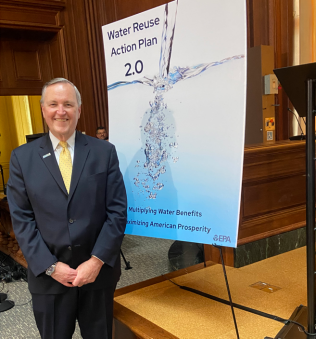
PMI CEO/Executive Director Kerry Stackpole and PMI federal government affairs representative Stephanie Salmon attended the launch of the Environmental Protection Agency’s Water Reuse Action Plan (WRAP) 2.0.
According to an EPA news release, WRAP is designed to “harness the power of water reuse for American industry, the artificial intelligence (AI) future, and American energy dominance while strengthening public health protections and safeguarding the nation’s water resources.”
EPA Administrator Lee Zeldin announced the plan at EPA headquarters along with EPA Deputy Administrator David Fotouhi, EPA Assistant Administrator for Water Jessica Kramer, members of Congress, and various other government officials and stakeholders.
“EPA’s Water Reuse Action Plan 2.0 recognizes a hard reality for plumbing fixture and fittings manufacturers: water availability is increasingly a limiting factor for growth, not just a utility input,” Stackpole said. “By advancing reuse, the program helps create a more reliable and predictable water supply for industrial operations while reducing pressure on freshwater systems that communities and businesses depend on. That’s a win-win for everybody.”
Zeldin emphasized that protecting the environment and growing the economy go hand in hand. “Water reuse has never been more important,” he emphasized. Kramer said she was “thrilled that WRAP 2.0 is bringing together a unique group of public and private leaders from American industry, technology companies, the energy sector, the water sector, and government.”
Not a federal mandate
WRAP 2.0 is not a federal regulatory mandate, the EPA release emphasized. In recognition that states and local leaders understand their water resources and needs best, the initiative leans on collaborative partnerships to advance reuse that strengthens key sectors of the U.S. economy. At the same time, these initiatives advance water reuse, protect public health, and bolster water resources.
The plan highlights water reuse strategies already underway, introduces new federal commitments, and charts a course for transformational progress over the next decade, the release stated. WRAP 2.0 is organized around three high-impact initiatives:
- Supporting reuse for resurgent domestic industry– Component fabrication (e.g., bottles and batteries), finished products (e.g., food and beverage products, cars, and trucks), and agricultural production.
- Water for the U.S. technology revolution– Microchip and memory fabrication and data center cooling.
- Unleashing American energy dominance– Electricity generation and energy development.
Water reuse will accelerate American prosperity by lowering costs and improving the predictability of water as an input for sectors that drive the American economy, including microchip fabrications and data centers that are essential to making the U.S. the artificial intelligence capital of the world, the EPA release stated. Similarly, WRAP 2.0 will advance energy dominance by driving down costs and supporting energy development and electricity generation. New actions will focus on opportunities to treat wastewater for beneficial reuse.
For decades, the economy has grown while Americans have benefited from improvements in public health and environmental protection, the release said. This will continue under WRAP 2.0, through initiatives that ensure that wastewater is treated appropriately for specific intended uses.
An example of ‘cooperative federalism’
The release stated that cooperative federalism is a hallmark of the Trump administration. Under WRAP 2.0, EPA will continue to enhance coordination and collaboration with state and federal partners to support the implementation of water reuse within existing regulatory authorities of the Clean Water Act, Safe Drinking Water Act, Food Safety Modernization Act, and Food Drug and Cosmetic Act for alternative sources of water and end-use applications.
In 2020, the first Trump administration launched WRAP in partnership with key water sector stakeholders as a collaborative effort to accelerate water reuse in the United States. At that time, WRAP included 37 strategic actions, with 86 partners making more than 100 commitments via a public docket to accelerate the adoption of water reuse. Today, 200 partners are working on 76 actions. In addition, more than 200 resources have been developed for the water reuse industry, and the interagency coordination embodied in WRAP is now codified into federal law, the release stated.
Find out more about Water Reuse Action Plan 2.0. (tinyurl.com/msps96c8)
Interested in Partnering with EPA on Water Reuse? (tinyurl.com/bdcvfhys)
PMI Webinar on Critical Trade Issues Updates Members
 By Ray Valek, PMI Communications, Valek and Co.
Milton Koch, international trade advisor for Buchanan Ingersoll & Rooney, provided Plumbing Manufacturers International members with the latest information about tariff refunds and other trade issues during an April PMI webinar.
The process of applying for International Emergency Economic Powers Act (IEEPA) tariff refunds is underway, following the Supreme Court decision invalidating these duties. PMI members can now claim refunds from United States Customs and Border Protection (CBP) through the Automated Commercial Environment (ACE) Secure Data Portal (tinyurl.com/ms2da8ah).
Koch said CBP told the Court of International Trade judge overseeing the IEEPA refund process that just under 56,500 importers or designated agents completed the paperwork necessary to apply for refunds as of April 9.
The Cato Institute reported that the first phase of the refund process includes only importers or agents with accounts in CBP’s electronic payment system; this phase is expected to account for 82% of the refunds, or about $127 billion of the $166 billion due to be refunded.
Koch advised PMI members who are importers of record or authorized customs brokers to establish an ACE account, enter bank account information, and submit detailed Consolidated Administration and Processing of Entries (CAPE) declarations in the portal. “You can’t say, ‘refund everything that I brought in as an importer, and Customs, you figure it out,’” Koch explained. “You have to tell Customs, on April 23, 2025, I had five shipments. They came in, it was this quantity, and I paid tariffs of $80,000. Please refund me that amount, plus interest. That’s the kind of detail that they’re looking for.” CBP has rolled out a webpage to assist: tinyurl.com/ak7p7rre
Meanwhile, various class action lawsuits have been filed claiming consumers should receive refunds for the extra costs incurred when purchasing products marked up due to the IEEPA tariffs, Koch stated. PMI members may be affected by similar lawsuits from their customers seeking a portion of any IEEPA tariff refunds received.
Only several hours after the Supreme Court decision, President Donald Trump announced that he would replace the IEEPA tariffs with Section 122 tariffs of 10%. The Section 122 tariffs can only last for five months, with an end date of July 24. “From the beginning, the Trump administration has made clear that the reciprocal (IEEPA) tariffs were intended as a temporary measure while trade negotiations took place. So, that bridge of reciprocal tariffs is now being replaced by Section 122,” Koch explained.
Separately, U.S. Trade Representative Jamieson Green stated that the Section 301 investigations would be completed by the July 24 end date of the Section 122 tariffs. Referring to Section 301 tariff investigations as a strong legal tool, Koch said these duties last for four years and can be applied very broadly and flexibly, typically for specific goods in specific countries. Section 301 tariffs are levied in response to “unfair trading practices” uncovered during the investigations, Koch explained.
There are two types of Section 301 investigations—excess capacity and forced labor. Focused on 16 economies, the excess capacity investigations center on many industries, including steel, auto and auto parts and other “unreasonable or discriminatory” imports that “burden or restrict U.S. commerce.” Sixty U.S. trading partners are subject to the forced labor investigations. “USTR’s point is that if you’re able to benefit from forced labor—either by getting a key raw material at a discount price, or you have cheaper labor when you’re manufacturing in that country—it places U.S. companies at a disadvantage,” Koch said.
Section 232 tariffs, which restrict the import of goods that “threaten or impair national security,” are also in play. While the first Trump administration implemented an exclusions process for these tariffs, the second administration “flipped the process on its head,” Koch stated. “The Trump administration ended all exclusions so that the Section 232 tariffs applied to all goods that were imported and they started an inclusion process” that allows U.S. producers to request that additional steel, aluminum or auto parts be added to the scope of national security tariffs.
Also on the Trump administration’s trade agenda is the United States-Mexico-Canada Agreement (USMCA). With a review scheduled for July, Mexico and the U.S. have initiated talks, with Canada reportedly behind in progress compared to Mexico. A revised agreement is not expected to be completed this year.
Koch also explained anti-dumping laws and countervailing duty (AD/CVD) laws that protect U.S. manufacturers from low-priced imports being sold at less than fair value or that are subsidized by foreign governments. For U.S. manufacturers injured by unfair, low-priced imports, AD/CVD investigations are a path to tariffs by law for renewable five-year periods. There has been a significant increase in AD/CVD investigations over the last several years. )
PMI members can view this webinar on demand and download slides at the link below under Trade/Tariffs -> Key Trends in Trade Impacting Plumbing Manufacturers.
tinyurl.com/bdy6hv48
Economic Impact Data Now Updated
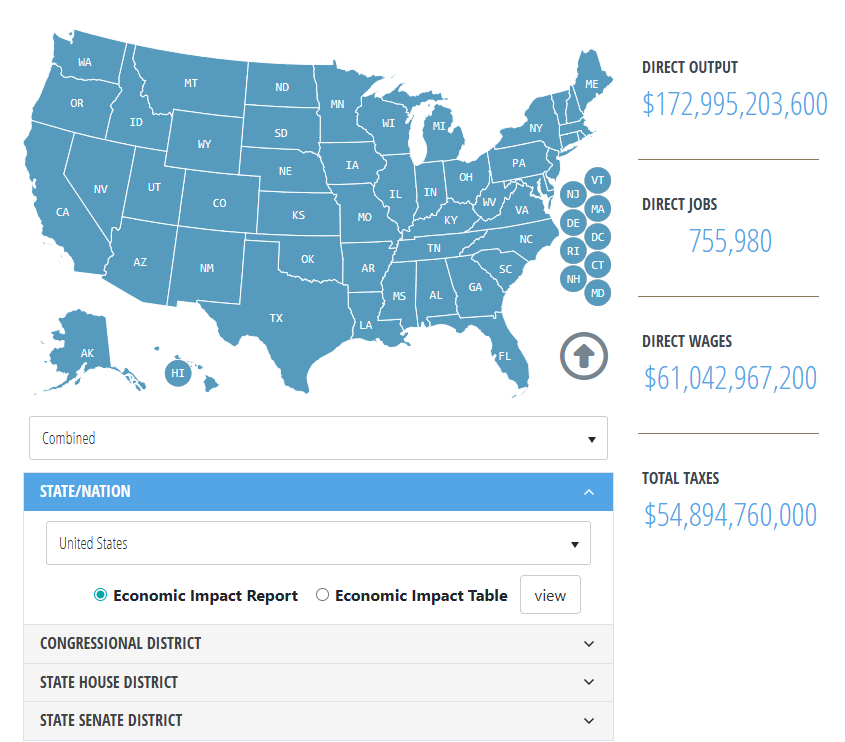
Plumbing Manufacturers International members can now create customized reports showing the latest economic impact data for plumbing manufacturers, plumbers, and the two industries combined. These data can be additionally sorted by direct or total economic impact, as well as by state and by congressional, state house, or state senate district.
The direct economic impact of both industries combined in the United States is $172.9 billion. The industries account for 755,980 jobs, $61 billion in wages, and $54.8 billion in tax revenue. The total economic impact of both industries—including suppliers to the industries and household spending by employees of the industries and suppliers—is $442.5 billion, 1.7 million jobs, and $142.1 billion in wages.
For plumbing manufacturers alone, the direct economic impact is $54.4 billion, 208,283 jobs, $14.3 billion in wages, and $17.7 billion in tax revenue. The total economic impact is $129 billion, 500,487 jobs, and $37 billion in wages.
These data are outstanding points to make to elected officials during plant tours or other kinds of outreach. Go to the economic impact webpage: (tinyurl.com/mtzaen9s). Also, read PMI’s “Take Your Lawmakers to Work,” a guide for hosting successful plant tours that includes a checklist, a sample invitation and thank you letter, and more helpful advice. (tinyurl.com/5n8e76e)