

October 2026
Counterfeit Plumbing: The Risk at the Tap

Kerry Stackpole
By Kerry Stackpole, IOM, FASAE, CAE, PMI CEO/Executive Director
The plumbing manufacturing industry operates on an extraordinary but largely invisible system of trust. Our customers turn on a faucet, step into a shower, or fill a glass of water with the reasonable expectation that the products delivering that water are safe and perform as intended.
Behind that confidence is an infrastructure of codes, standards, testing, and third-party certification. It is easy to think of certification as an administrative requirement—a mark stamped on a box or another step before a product reaches the marketplace. It is much more than that.
Product certification is part of the public-health infrastructure of plumbing. Our customers cannot see lead. They cannot test a pressure-balancing valve at the checkout counter. They cannot determine whether a faucet meets applicable drinking-water requirements simply by examining its finish. Third-party certification provides that independent checkpoint. Put simply, certification turns “trust us” into “prove it.”
That safeguard has become increasingly important as e-commerce transforms how plumbing products reach our customers. Global commerce itself is not the problem. Reputable manufacturers operate sophisticated international supply chains while maintaining rigorous engineering, testing, certification, and quality-control programs.
The problem arises when e-commerce separates the product from the accountability behind it. Today, people can purchase plumbing products in seconds from sellers located virtually anywhere. A listing may claim that a product is code-compliant. It may display a recognized certification mark. It may look nearly identical to a legitimately manufactured and certified fixture. But a polished photograph is not proof of compliance.
Plumbing Manufacturers International member Moen’s testimony before the U.S. Senate Judiciary Subcommittee on Intellectual Property in 2025 illustrated the stakes. Of 19 off-brand faucets evaluated, 17 failed drinking-water health and safety standards. Eleven leached lead above allowable levels, including one reportedly exceeding the limit by more than 500%. Fifteen contained chemicals associated with serious health effects.
That gives the industry an important message to communicate: a counterfeit handbag may disappoint you but a counterfeit faucet can expose your family to lead. The danger is not limited to what comes out of the faucet. It also involves whether products perform properly when something goes wrong. In a separate evaluation reported by IAPMO, six foreign-made, pressure-balancing valves failed ASSE 1016 requirements, with one exceeding safe temperature thresholds by 750%. Products that appear virtually identical from the outside can perform very differently behind the wall.
Counterfeit certification marks compound the problem because they attack the system designed to establish trust. When an unscrupulous seller places a fraudulent certification mark on a product, it appropriates something far more valuable than a logo. It attempts to appropriate the credibility created by standards development, laboratory testing, certification, manufacturing quality systems, and marketplace surveillance. A fake certification mark doesn’t just counterfeit a logo—it counterfeits trust.
There is also a fundamental issue of fairness. Responsible manufacturers invest substantial resources in engineering, testing, certification, regulatory compliance, and corrective action. Sellers that evade those responsibilities can translate noncompliance into a price advantage. That leaves legitimate manufacturers facing unfair competition, certifiers confronting misuse of their marks, distributors and installers facing potential liability, code officials carrying additional enforcement burdens—and our customers potentially becoming the final quality-control checkpoint. They should never occupy that position.
Addressing the problem requires a coordinated response. Manufacturers, certification organizations, plumbing and mechanical officials, regulators, customs authorities, and online marketplaces all have roles to play. We need stronger product traceability, easier verification of certification marks, rapid removal of unlawful listings, better information sharing, and meaningful consequences for repeat offenders.
Plumbing and mechanical officials occupy an especially important position in this chain. In some cases, the inspector may be the last knowledgeable professional to examine a product before it becomes permanently installed in a building—and connected to someone’s drinking-water system.
The enormous convenience of e-commerce should not require compromising the safeguards generations of plumbing professionals have built.
The principle should be straightforward: if we cannot verify it, we should not trust it—and we should not install it. Ultimately, this issue is bigger than intellectual property, marketplace competition, or even certification itself. It is about maintaining an unbroken chain of trust—from standards, to testing, to certification, to installation, and finally to safe water at the tap. A counterfeit faucet is not a bargain. It is an unverified risk connected directly to the public’s water supply, and that’s a risk no one should take.
PMI Report Features Global Village of Plumbing Manufacturing

Plumbing Manufacturers International’s 2026 Annual Report explores what it truly takes to bring a plumbing product to life on a global scale: the international partnerships, the technology collaborations, the supply chain ingenuity, and the people who make it all work across time zones and cultures.
The report’s theme, “It Takes a Global Village to Deliver a Plumbing Product,” is a story PMI members live every day.
Representative of PMI’s entire membership, nine PMI members volunteered to participate in interviews that provide a glimpse into their international operations and how they innovate to deliver value to customers and our society each day. In addition, the report provides a summary of what PMI accomplished during the past 12 months by engaging with members. These accomplishments saved members significant costs relating to manufacturing and regulatory compliance. The report includes narratives about:
- International teams advancing technology, sustainability, or supply chain resilience through knowledge exchange.
- Global sourcing, component partnerships, or distribution and marketing inside and outside the U.S.
- The real-world challenges of coordinating across time zones and cultures—and how companies overcome them.
- Countries or regions where the industry’s work has been especially impactful or rewarding.
- What makes global collaboration genuinely productive—and worth the effort.
The report provides visibility to the people and partnerships behind our members’ products and contributes to an ongoing, industry-wide conversation about the future of global manufacturing and trade.
Here is the report’s article line-up:
- NSF Contributes to Single, Harmonized EU Drinking Water Standard
- The Sun Never Sets on Haws
- LSP Products Rethinks Supply Chain in Response to Tariffs
- A Kohler Shower That Reduces Water Use Up to 80%
- TOTO Celebrates 20th WaterSense Anniversary with Continual Innovation
- Sloan Expands Manufacturing to India and Beyond
- It Takes Member Engagement to Manufacture Success
- Falcon Produces OEM Products with Worldwide Network of Partners
- GF Creates Global Sustainability Organization
- BLANCO Focuses on the Kitchen—the Functional and Emotional Center of the Home
Read the report at https://tinyurl.com/3vep9n2z
Customs Compliance Requires More Risk Mitigation
By Judy Wohlt, PMI Communications Team, Valek and Co.
The federal government’s message to importers has become clear: customs compliance is no longer simply a regulatory matter—it’s increasingly a criminal enforcement priority.
This caution was the key takeaway from a recent Plumbing Manufacturers International webinar featuring trade attorneys Lars-Erik Hjelm, a partner in Akin’s international trade practice, and Gerry Moody, a partner in Akin’s white-collar defense and government investigations practice and leader of the firm’s tariff enforcement defense group.
They outlined how the Trump administration has dramatically expanded customs compliance efforts and what plumbing manufacturers can do to reduce risk.
New task force turns up the heat
A pivotal shift to strengthen customs fraud and tariff evasion investigations came in August 2025 with the launch of the Trade Enforcement Task Force—a joint initiative bringing together the Department of Justice (DOJ) and Department of Homeland Security (DHS). The task force coordinates closely with Customs and Border Protection (CBP), combining criminal, civil and investigative resources.
“Trade fraud has gone from being a relatively low priority to one of DOJ’s top enforcement areas almost overnight,” Moody said.
The result is closer coordination among federal agencies, increased data sharing, and more investigations targeting alleged customs violations, he noted. The task force also encourages companies to report suspected duty evasion in their supply chains.
Civil cases are becoming criminal cases
Historically, many customs issues were resolved through civil enforcement. However, today’s environment leans toward pursuing criminal enforcement, Moody explained.
The DOJ has established dedicated trade fraud prosecutors to pursue criminal charges in the most serious cases. Criminal investigations also enhance investigative powers, including search warrants, subpoenas, and broader cooperation among agencies such as DHS and the FBI, Moody noted.
Robust civil enforcement continues. The False Claims Act remains a powerful tool for pursuing companies accused of underpaying duties through undervaluation or other improper practices, he shared.
Because whistleblowers can receive 15% to 30% of recoveries, companies should expect continued reporting by employees, competitors, and other industry participants, Moody added.
Investigators look to whistleblowers, data
Moody and Hjelm identified several enforcement priorities that manufacturers should understand.
Common allegations involve misrepresenting a product’s country of origin, misclassifying imported goods, undervaluing merchandise, submitting multiple invoices with different values, and violating product safety requirements. Transshipment—routing products through another country to avoid higher tariffs—continues to receive particular scrutiny, Hjelm pointed out.
The administration has also expanded DOJ’s Corporate Whistleblower Awards Program to include customs and tariff violations, adding another avenue for potential enforcement referrals, Moody emphasized. Whistleblower complaints for duty evasion increased by more than 50% in 2026 compared to previous years, he added.
The DOJ has boosted use of data analytics and artificial intelligence to identify suspicious trade patterns—without waiting for a whistleblower complaint, Moody asserted.
Compliance starts at the top
Effective compliance programs are becoming more important than ever for manufacturers.
Successful programs begin with visible management commitment and a culture that prioritizes trade compliance, Hjelm emphasized. Companies should ensure employees receive regular training, maintain strong internal controls, and develop greater visibility throughout their supply chains—including upstream suppliers, he suggested.
That visibility has become especially important as CBP continues aggressive enforcement of forced labor restrictions and expects importers to document supply chain origins in extraordinary detail, Moody observed.
Hjelm recommended maintaining internal reporting mechanisms, such as whistleblower hotlines, so trade concerns can be addressed before they become government investigations.
Know the red flags
Manufacturers should also watch for warning signs within their own operations and supply chains.
Potential indicators include unexplained declines in supplier pricing, inconsistent countries of origin, discrepancies between purchase orders and customs filings, changes in importer-of-record information, and suppliers offering separate invoices for customs purposes, Hjelm explained.
“These same indicators are increasingly being used by competitors and government agencies to identify potential enforcement targets,” Moody added.
PMI members can view this webinar on demand and download slides under Trade/Tariffs, “Navigating the Intensifying U.S. Customs Enforcement Landscape” at https://tinyurl.com/yyf2hckc.
This article is not intended as legal advice. Companies should seek legal counsel specific to their needs and situation.
PMI26: Connect, Think Big and Make Your Next Move
By Judy Wohlt, PMI Communications Team, Valek and Co.
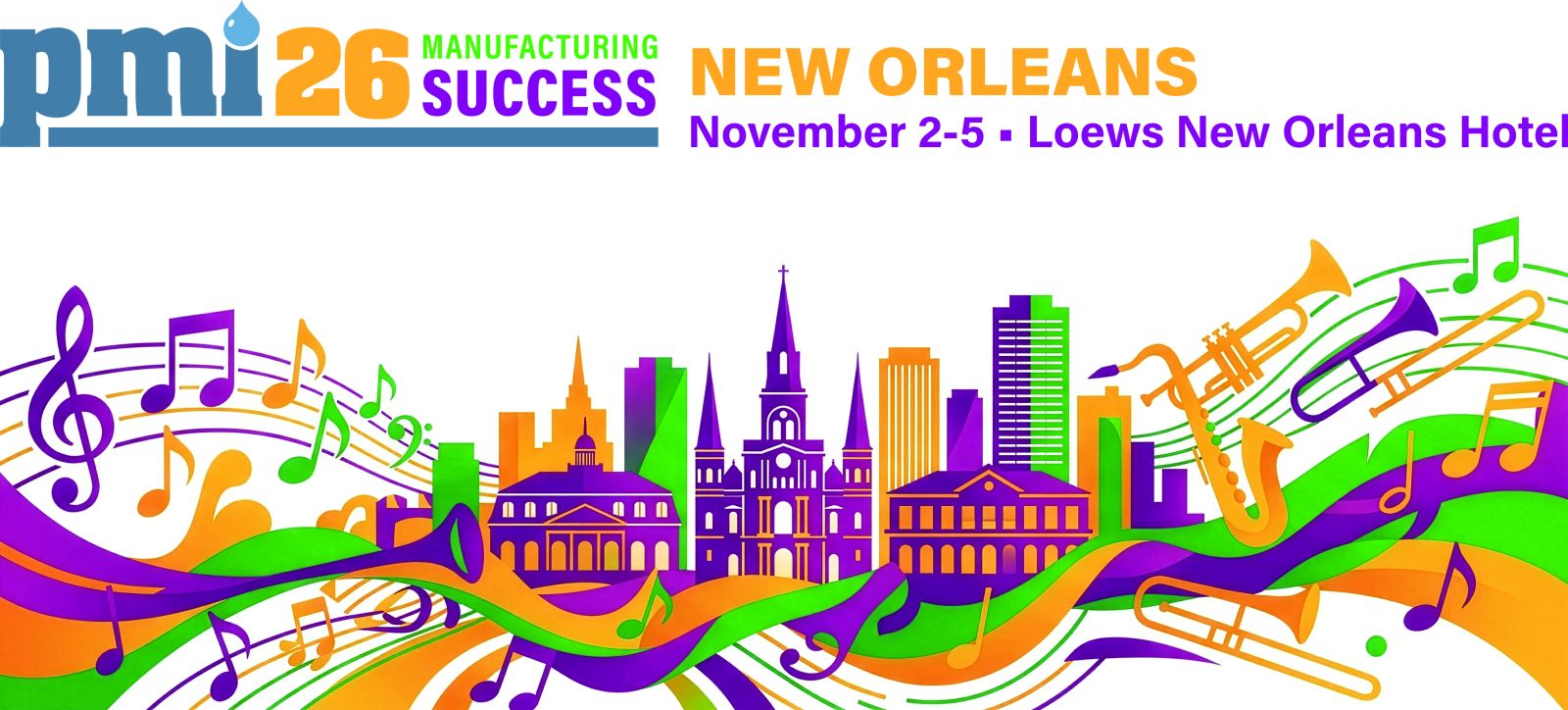
Return to work energized and with new ideas to move yourself, your team, and your company successfully into the future. Attend the PMI26 Manufacturing Success Conference in New Orleans, Nov. 2-5.
You can join the PMI Market Outlook LIVE session led by ITR’s Connor Lokar and learn economic insights to help plan for a new product sales strategy. Or, you’ll meet a presenter who becomes a valuable resource. Perhaps you’ll find inspiration from Alex Weber’s keynote to turn a recent career setback into a leap forward.
And there’s much more.
Gain insights into AI and manufacturing
Knud Berthelsen, professor of practice and senior advisor for AI literacy at Tulane University in New Orleans, is the latest addition to the PMI26 agenda. His work focuses on applied AI literacy and the impact of AI on society, including its impact on manufacturing. His presentation will provide insights into AI literacy, as well as AI strategy, implementation, integration, and training.
Get expert insight into your workforce challenges
If you have a workforce challenge that’s been keeping you up at night, you won’t want to miss the Skilled Workforce Panel Discussion. Joining the expert panel will be Tim Johnson, founder and president of TJC Group. He brings more than 35 years of experience helping organizations build relationships with communities and elected officials.
Johnson has advised some of the world’s largest industrial companies and established more than 60 community advisory councils and panels across eight states. He helps organizations build knowledge, strengthen understanding, and earn the trust of key stakeholders.
His experience spans business, government, construction, and workforce development. He spent six years as a lead committee staffer for the Louisiana State Senate, served as director of business development for the Shaw Group’s construction and maintenance division, and worked as executive director of the Associated Builders and Contractors Pelican Chapter, leading one of the largest privately funded construction craft training centers in the U.S.
See water through a national economic security lens
What does water have to do with national economic security? The answer is: nearly everything, according to John Sabo, a professor in the Department of Coastal and River Science and Engineering at Tulane University, and director of the university’s ByWater Institute
In “Water as the Cornerstone of U.S. National Economic Security,” Sabo will explore how water underpins critical sectors, including manufacturing, food and beverage, energy, textiles, and IT. He’ll examine the growing challenge of water extremes and volatility—and the need to invest now in built, natural, cyber, and social infrastructure to strengthen resilience.
Sabo is an internationally recognized water and river ecologist whose research has received more than $14 million in grants from the National Science Foundation, Department of Defense, U.S. Geological Survey, and many other private and public organizations. His work spans major river systems around the world, including the Colorado, Mekong and Amazon.
He leads the ByWater Institute’s efforts to connect Tulane’s water expertise across disciplines and accelerate research with real-world impact. The institute supports collaborative research and partners with government, industry, nonprofits, and international organizations to develop innovative solutions for water resilience.
Navigate the global trade landscape
International trade continues to shape the business environment for plumbing manufacturers. Brian Ledgerwood, an international trade specialist with the Department of Commerce’s International Trade Administration, will provide an inside look at trade trends affecting the plumbing products industry.
His session, “The Global Trade Landscape: What Plumbing Manufacturers Need to Know,” will cover the International Trade Administration, its International Trade Advisory Committee program, and updates on trade policies affecting the plumbing products sector.
Come for the ideas, stay for the connections
If you attended PMI25, you already know the conference’s value extends beyond the sessions.
“I always enjoy the networking. All presentations were relevant, engaging and thought-provoking,” one PMI25 attendee said.
Others highlighted “the interaction with others in the industry,” “the in-person networking,” and “inspirational speakers.”
Another attendee summed up the experience this way: “Appreciate getting an update and recommendations on important matters, connecting with colleagues, and exchanging ideas.”
That will be PMI26: new ideas, new connections, and new ways to think about the future.
Register for PMI26 at https://tinyurl.com/395mawzf.
 Congrats to the Paul Patton Award Recipient! Angela Jimenez, a product and quality manager at Neoperl, has been selected as the recipient of the Paul Patton PMI26 Manufacturing Success Award. Nominated by J’aime Salvatore, managing director at Neoperl, Jimenez started in technical sales at Neoperl 11 years ago before advancing into roles in product management. In her current position, she supervises a staff of three people responsible for product quality and regulatory compliance. “Like Paul Patton, Angela shares an inquisitive mindset and attention to detail. She also enjoys sharing her knowledge and helping the next generation. Her product knowledge, solution-oriented mentality, and general demeanor make her a pleasure to work with,” Salvatore stated. A participant on PMI’s Technical and Advocacy/Government Affairs Committees, Jimenez is looking forward to attending her fourth consecutive PMI Manufacturing Success Conference and first PMI Inspiring Leaders Program. She also frequently participates in PMI’s webinars, including the recent Part 2 of the Codes and Standards Series, “How to Meet Product Compliance Standards: A High-Level-to-Detail Review,” facilitated by PMI Technical Director Kyle Thompson. Please extend a hearty congratulations to Angela Jimenez! |
U.S.-Canada Trade Dispute Adds New Plumbing Tariffs

By Judy Wohlt, PMI Communications Team, Valek and Co.
A trade dispute between the United States and Canada recently escalated, with Canada responding to the Trump administration’s 50% tariffs on certain Canadian products announced in late August. On Sept. 8, Canada imposed retaliatory tariffs of 25% to 50% on certain U.S. plumbing product exports, as part of tariffs ranging from 15% to 50% on about $20 billion of U.S. goods, Reuters reported.
American plumbing product categories affected by 25% duties when exported into Canada include stainless steel sinks and wash basins, and iron/steel sanitary ware, noted Stephanie Salmon, PMI’s federal government affairs consultant. Both of those product categories are also subject to 25% U.S. Section 232 tariffs when imported from Canada, she added. Canada also imposed 50% tariffs on aluminum doors, windows, frames (including shower door frames), thresholds, and structures. Those aluminum products are also subject to 50% U.S. Section 232 tariffs when imported from Canada.
“Canada typically represents one of our largest export markets and is our largest overall trading partner,” Salmon emphasized. These tariff conflicts have become moving targets and remove predictability from business planning for plumbing manufacturers and other businesses, she maintained.
Negotiating to resolve differences
“We would like to see the two countries come back to the table and negotiate to iron out any differences, honoring the United States-Mexico-Canada Agreement,” emphasized PMI CEO/Executive Director Kerry Stackpole. “These disagreements and the resulting higher tariffs on plumbing products drive up costs for manufacturers, plumbers, contractors, and ultimately, homeowners in both countries.”
PMI continues to support fair and practical trade policies. “A predictable, open trade environment is essential for plumbing manufacturers to operate efficiently, compete in the global marketplace, and meet customer needs,” Stackpole added.
In July, the Trump administration announced that the USMCA remains in effect, but with annual reviews. The reviews will “address the agreement’s shortcomings and our trade deficit with Canada and Mexico,” stated a July United States Trade Representative news release. The USMCA, which President Donald Trump had negotiated and signed, replaced the North American Free Trade Agreement, which had been in effect since 1994.
For plumbing manufacturers, the uncertainty surrounding the USMCA adds another layer of complexity to cross-border trade, sourcing and investment decisions. PMI continues to advocate for trade policies that provide manufacturers with greater certainty. Stackpole encourages PMI members who would like to monitor tariff changes and this U.S.-Canada situation to participate in the PMI Advocacy/Government Affairs meetings.
Product Compliance: Beyond Certification to Lifecycle

By Judy Wohlt, PMI Communications Team, Valek and Co.
Getting a plumbing product to market involves much more than finding the right certification standard. Product compliance requires a commitment to continuously verifying requirements throughout a product’s lifecycle.
Kyle Thompson, Plumbing Manufacturers International technical director, shared that central lesson during a recent webinar covering Part 2 of the PMI Codes and Standards Series, “How to Meet Product Compliance Standards: A High-Level-to-Detail Review.” He discussed how manufacturers can navigate the complex web of federal requirements, codes, standards, testing, certification, and ongoing compliance.
Start with the product
When a new product lands on your desk, the first step shouldn’t be to search for a certification mark. Instead, work from the product outward to determine which requirements apply, Thompson suggested.
“The process starts with two basic questions: What is the product? What does it do? Then ask where and how it is intended to be used,” he stated. Those answers help plumbing manufacturers identify the applicable federal laws, regulations, codes, and standards.
From there, identify health and material requirements, applicable product standards, required testing, and the appropriate certification pathway, he added.
Use a ‘cheat sheet’
Manufacturers don’t need to memorize every applicable standard; they need a framework to determine which requirements apply, Thompson emphasized. He provided a “cheat sheet” to quickly match a family of plumbing products and subcategories to the correct standard.
For example, under “fixtures,” the sheet shows the standard ASME A112.19.2/CSA B45.1 applying to “ceramic plumbing fixtures” and the standard CSA B45.5/IAPMO Z124 applying to “plastic plumbing fixtures.” The sheet also lists standards for supply fittings, waste fittings, fixture components, and plastic piping.
“We’re professionals here, engineers, and looking things up is our forte,” he explained. “The goal is to know where to look for the answer, rather than trying to commit every standard to memory.”
Compliance is cumulative
Another key takeaway is that compliance requirements are not interchangeable.
For example, a kitchen faucet may need to address federal lead-free requirements under the Safe Drinking Water Act, federal water-efficiency standards under the Energy Policy and Conservation Act, health-effects requirements under NSF 61, and product performance stipulations under an applicable product standard, Thompson maintained.
The webinar also emphasized that standards do not operate in isolation. One certification standard may reference other standards to address product performance, health effects, and manufacturing quality, he added.
Certification starts the process
Certification is not simply a test result. It is a controlled process that connects an approved design and materials to a listed product—and the products that continue to leave the manufacturing facility. That means manufacturers must consider what happens after certification, Thompson explained.
He listed production surveillance, change control, annual audits, facility inspections, records reviews, product sampling, and retesting as all part of ongoing conformity assessment. Changes to a product may require notifying a third-party certifier, additional testing, or a new certification review, Thompson offered.
Changes in formulation or suppliers can be particularly important for products certified to NSF 61, which evaluates contaminants that may be indirectly imparted to drinking water from materials, components, products, and systems, he shared. Manufacturing location and tooling changes may also need to be reported.
Third-party certification doesn’t necessarily satisfy every federal obligation either, he added.
Five steps to ongoing compliance
Thompson wrapped up by discussing five key steps for managing a new plumbing product: 1) define the product and its intended application; 2) determine its regulatory coverage; 3) identify health and material requirements; 4) determine the applicable product standard, testing and certification pathway; and 5) account for ongoing continuous compliance obligations.
“The goal isn’t to memorize every standard. It’s to establish a repeatable process for finding the right answers—and to recognize that the work doesn’t stop once the product is certified,” he concluded.
PMI members can watch Thompson’s full Part 2 presentation on-demand and download his slides and “cheat sheet” under PMI Webinars/Videos and Technical/Regulatory at https://tinyurl.com/3nfkmkp9. Part 1 of the series is available at https://tinyurl.com/n3v468ma.
Set Clear Expectations to Achieve AI Readiness
By Judy Wohlt, PMI Communications Team, Valek and Co.
Employees who simply open and start using Claude, ChatGPT or another AI tool don’t make a company AI-ready. Organizations need the right leadership direction, defined processes, clear expectations, and controls to turn AI into reliable business results, suggested Clevette Coombs, AI and sales strategist, as she led a recent Plumbing Manufacturers International Inspiring Leaders Workshop on “AI-Ready Leadership: How Inspiring Leaders Can Use AI Without the Overwhelm.”
She noted how employees are adopting AI use much faster than leaders feel comfortable—leaving a gap between individual use and reliable organizational results. A July 2026 McKinsey study showed that 70% of employees feel personally prepared to use AI while only 27% of leaders say their organization is ready.
It starts with leadership
To turn AI into reliable work, she described four key steps: direction, workflow, people, and controls. “Tools are one part of readiness. Leadership establishes the system around them,” she maintained.
Leadership must determine business priorities, where AI can create value, and decision-making authority over AI, she noted. Workflow means providing a defined process for people, data and AI.
People need clear expectations, practice and support from their managers to prepare for changed work using AI. Finally, controls define what the system may read, write and change, along with proper reviews and measurements, Coombs shared.
Four tools with different strengths
She described the four AI tools used most—ChatGPT, Claude, Gemini, and Copilot—as four co-workers who speak one language but possess different strengths.
All four are powered by large language models, which are trained on massive amounts of text that “predict” the next word in a sentence so “it sounds like a person,” she explained.
Coombs shared that Claude is her preferred AI tool and explained that its strengths lie in writing copy and analyzing long documents. “Choosing the right [tool] depends on your work and what your company allows,” she added.
She warned that “none of these tools are perfect, and they all hallucinate…It will give you great wrong answers sometimes, so the onus falls on you to double-check the work.”
While the tools may differ, the basic approach remains the same: give AI clear instructions, provide approved information, and review what it produces, she emphasized.
Creating repeatable workflows
Coombs challenged participants to move beyond one-off AI experiments to using detailed prompts and a reusable “skill”—a written procedure for a task used to communicate with various AI.
Prompts are a specific work order with context, outcome and constraints. A “skill” can capture standing instructions, intake questions, output requirements, and quality checks, making a successful workflow easier to repeat, she offered.
The potential applications for plumbing manufacturers were plentiful. Examples included analyzing warranty claims by product line, creating a brief from an approved standards update, drafting an email about a production delay, and developing a presentation outline. These are repetitive, reviewable tasks where AI can help employees save time without replacing human judgment, Coombs explained.
PMI members can review the workshop’s slides and handouts at https://tinyurl.com/2dkf75dp