

September 2026
Do You Remember Your First PMI Conference? I Do
Bob Neff
By Bob Neff, PMI Board of Directors President, Delta Faucet Company
The very first Plumbing Manufacturers International conference I attended was in Chicago in 2016. At the time, Paul Patton, who was the 2016 president of the PMI Board of Directors, encouraged me to attend, highlighting the unique opportunities the conference offered. Looking back, his description could not have been more accurate.
Attending that conference transformed my PMI experience. Before then, I regularly joined Technical Committee calls, primarily as an observer. While I valued the discussions, I rarely contributed. It quickly became apparent that PMI members possessed expertise across an impressive range of topics, and as a newer participant, I often hesitated to share my perspective. That changed after my first conference.
The networking opportunities allowed me to connect faces with names and discover that PMI members are incredibly generous with their knowledge, guidance and experience. The sense of community and mentorship I experienced helped remove the barriers that had prevented me from actively participating. Equally important, the diverse range of conference topics provided insight into industry challenges and opportunities that motivated me to become more involved.
Something for everybody
PMI encourages employees of member companies to attend the conference. Regardless of your role, the conference offers valuable opportunities to learn, engage and gain a broader understanding of issues affecting our industry.
As our annual conference has evolved, PMI now offers the PMI Inspiring Leaders Program, the Women of PMI Breakfast, and a chance to participate in an activity that benefits a good cause. The growth and evolution of the conference since I first attended have been remarkable. There truly is something for everyone.
A chance to become involved and advance your career
At the conference, everyone puts on their PMI hat and puts the competitiveness aside for a few days. Everyone is encouraged to speak, engage in discussions, and contribute their perspectives. The motivation I gained from my first conference led me to pursue a co-chair position. Along the way, I learned that the problems and challenges I faced, and to some extent those faced by my company, are largely shared across the membership. You realize that we’re all in it together.
Connecting people, ideas and knowledge
If I had to describe the PMI conference in one word, it would be connections. The conference connects people, ideas and knowledge. The program covers an array of topics—technical, advocacy, professional development, and more. Just as important, it helps attendees see how these subjects intersect and influence one another. Afterwards, I always feel more informed about the plumbing industry than I was before.
Build a professional network
At any given conference, there are multiple topics that are incredibly relevant. The speakers themselves often become valuable professional connections, frequently sharing their contact information and welcoming future conversations. Often, we find a new idea, service or resource that we may not have encountered otherwise. One advantage of PMI’s close-knit community is the accessibility of industry experts. Attendees have meaningful opportunities to ask questions and engage directly with presenters. Where else are you going to be able to have a conversation with a Ph.D. in a niche scientific area?
Bring back insights to your company
When I go back to my office and share insights and lessons learned from the conference, usually those conversations are, “That’s amazing. I would like to attend myself in the future,” or “We need to think about that a different way.” For example, Commissioner Andrew McAllister from the California Energy Commission attended our meeting in Sonoma County several years ago. His remarks provided valuable insight into regulatory perspectives and sparked productive discussion about how PMI could engage more effectively on key industry issues.
I encourage everyone to attend PMI26. Whether you are looking to expand your professional network, gain new industry insights, strengthen your leadership skills, or become more involved in PMI, the conference offers tremendous value. For me, attending my first PMI conference opened doors I never expected and ultimately led to opportunities for greater involvement and leadership within the organization. I hope PMI26 will do the same for you, and I look forward to seeing you there.
AI and the Human Connection

Kerry Stackpole
By Kerry Stackpole, IOM, FASAE, CAE, PMI CEO/Executive Director
If you’re like me, you’ve probably been thinking about artificial intelligence—a lot. Is AI just the latest information grab, like earlier technologies that captured and re-sold our personal information for varied purposes? Are AI companies just collecting and re-selling what we humans created in the first place? Or is there something more to all the buzz?
Artificial intelligence is rapidly changing how business gets done. It can analyze enormous amounts of information, draft reports, summarize meetings, identify patterns, answer questions, automate routine work, and increasingly serve as an always-available adviser. The productivity gains are likely to be real, and they are only beginning.
But there is an interesting paradox emerging alongside this technological revolution: the more capable AI becomes, the more valuable genuine human connection will become. As a business leader, that deserves your attention.
For decades, technology has steadily reduced the need for physical interaction. Email replaced many conversations. Video meetings replaced travel. Remote work eliminated countless informal encounters. AI potentially eliminates another layer of interaction. Instead of asking a colleague for help, you can ask an AI assistant. Instead of brainstorming with someone down the hall, you can brainstorm with a machine. Instead of calling an expert, you can obtain a sophisticated answer in seconds. Is this really a good thing?
While individual decisions may make perfect sense, collectively they create a risk. You can become extraordinarily connected technologically while becoming increasingly isolated personally. As a leader, you cannot afford that tradeoff.
AI can provide information, but leadership depends on much more than information. Leaders must create trust, read a room, understand what is not being said, resolve disagreement, inspire confidence, show empathy, and persuade people to pursue objectives together. Those capabilities emerge from relationships. This means human connection should increasingly be viewed not simply as a cultural virtue, but as a strategic business asset.
Consider the workplace. Some of the most consequential conversations rarely appear on an agenda. They occur before a meeting begins, over lunch, during a hallway conversation, or when someone closes the office door and says, “Can I run something by you?” These interactions transmit context, build trust, and often reveal problems long before they appear on a dashboard or on your desk.
While AI has the potential to make your organization more efficient, as a leader you must make sure efficiency does not inadvertently engineer those moments out of the workplace. There is another danger. Today’s AI is engineered to be extraordinarily agreeable and patient. Human beings are not. Working with people requires you to encounter different personalities, competing priorities, uncomfortable questions, and opposing viewpoints. That friction can be frustrating, but it is also where judgment develops. Leaders who increasingly retreat into personalized digital environments risk creating intellectual isolation, as well as social isolation. The real leadership challenge, therefore, is not choosing between technology and humanity. It is determining what technology should replace and what it should protect.
AI excels at tasks machines perform well: processing information, identifying patterns, generating alternatives, handling repetitive work, and accelerating routine decisions. As a leader, you will want to deliberately reinvest some of the time saved into activities humans perform uniquely well: conversations, mentoring, collaboration, relationship building, listening, and simply spending time together.
That may require intentional leadership. Pick up the phone rather than sending another message. Have lunch with a colleague without an agenda. Visit employees, customers and partners. Create meetings where people actually talk rather than merely exchange PowerPoint slides. Make room for disagreement. Ask questions and listen long enough to hear answers you did not expect.
The great promise of AI is that it can give us back something extraordinarily scarce: time. What you as a leader choose to do with that time may ultimately matter more than the technology itself. In an increasingly artificial world, authenticity becomes scarce. And scarcity creates value.
As you ponder AI, one of the most important leadership lessons of this era will be surprisingly old-fashioned: the more intelligent our machines become, the more intentional you will need to be about remaining human.
Forging Alliances for Stronger Water, Workforce Policies
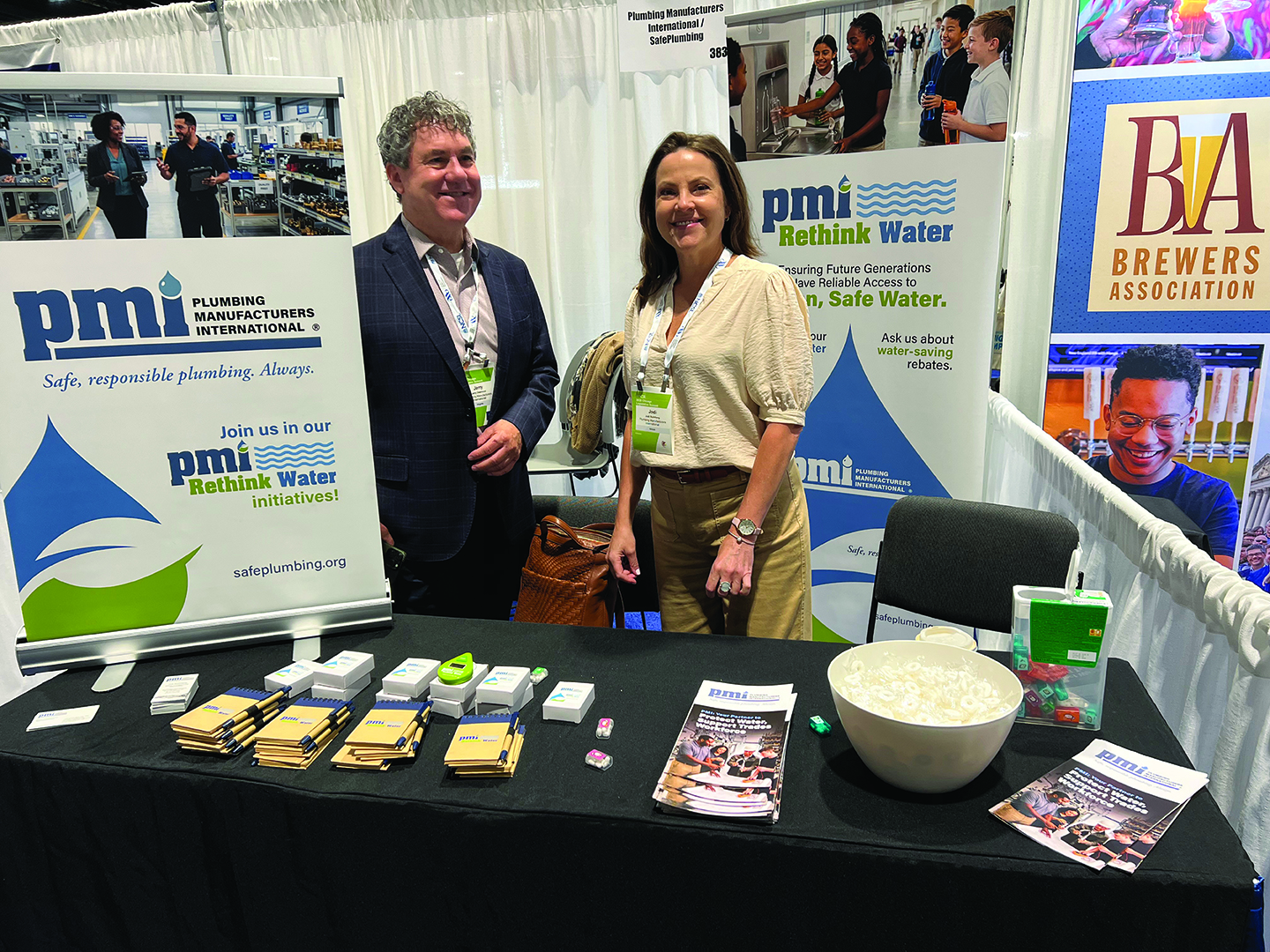
Jerry Desmond and Jodi Stuhrberg work the PMI booth at the NCSL Legislative Summit
By Judy Wohlt, PMI Communications Team, Valek and Co.
Countless connections with like-minded organizations. Hundreds of conversations. One goal: advancing policies that promote water efficiency, strengthen the skilled trades workforce, and support filter-first legislation. That shared purpose fueled the Plumbing Manufacturers International team’s strong presence during the recent National Conference of State Legislatures (NCSL) Legislative Summit in Chicago.
During the three-day event, PMI director of state government affairs, policy and advocacy Matthew Windrum attended various sessions, lunches and meetings while director of programs and administration Jodi Stuhrberg, technical director Kyle Thompson, and California government affairs consultant Jerry Desmond worked the PMI booth.
“We tag-teamed and collaborated,” Stuhrberg explained. “We completed the circle of promoting PMI and our branding.” While Windrum directed session attendees to the booth, Desmond and Thompson fielded policy and technical questions. Together, the team highlighted skilled workforce challenges and solutions facing the plumbing manufacturing and plumbing industries and demonstrated how PMI members advance water efficiency, she shared.
PMI’s five-minute Rethink Water shower timers proved to be a crowd favorite, with supplies nearly exhausted on the first day, Stuhrberg noted. Attendees also picked up information about the Rethink Water initiative, water efficiency, skilled trades, filter-first and clean water legislation, and the significant economic impact the plumbing manufacturing and plumbing industries have on the American economy.
The summit attracted more than 7,000 attendees to Chicago’s McCormick Place for bipartisan discussions on issues that “both divide and unite us,” reported the NCSL website. Speakers included Illinois Gov. JB Pritzker, Oklahoma Gov. Kevin Stitt, and Nobel Laureate Geoffrey Hinton of the University of Toronto, who spoke about “The Promise and Peril of AI.” Attendees talked with representatives from more than 275 corporations, government agencies, trade associations, special interest groups, and consulting firms.
Housing and workforce connect
Windrum attended several sessions that reinforced the connection between affordable housing and the skilled trades workforce. During one housing panel, legislators and thought leaders explored strategies to accelerate home construction to address the affordability crisis—efforts that would also strengthen the plumbing manufacturing and plumbing industries, he emphasized.
Windrum said he was happy to hear legislators discussing the skilled trades and the importance of empowering the private sector as a key partner in developing workforce development initiatives. A lunch with New York state legislators produced productive conversations around the skilled trades workforce and a chance to help policymakers better understand how PMI and its members support the plumbing trade, Windrum noted.
“Workforce issues seemed to get the most immediate traction and prompt agreement. Water sustainability sparked curiosity and gave us valuable opportunities to explain PMI’s leadership in water efficiency,” Windrum remarked.
Broadening coalitions
The summit helped PMI strengthen relationships with other durable goods associations and identify opportunities to collaborate on workforce development and shared policy priorities, Windrum shared.
PMI representatives exchanged ideas with leaders from the Air-Conditioning, Heating and Refrigeration Institute, Consumer Technology Association, National Marine Manufacturers Association, and American Motorcyclist Association, as well as AMERIPEN, American Chemistry Council, American Alliance for Innovation and Infrastructure, and PMI member IAPMO. These conversations broadened PMI’s coalition and reinforced common priorities across industries.
PMI26: Big Ideas, Bonding and a Few Surprises in NOLA
By Judy Wohlt, PMI Communications Team, Valek and Co.
Educational opportunities, fun networking activities, and a few surprises await those attending the PMI26 Manufacturing Success Conference, Nov. 2-5, in New Orleans.
Explore the latest strategies for addressing security risks in manufacturing. Hear skilled trades experts discuss workforce development. And discover how product innovation can help manufacturers rethink effective water governance.
Exciting, locally inspired surprises will add to the experience. Attendees will have plenty of opportunities to network—and explore the historic French Quarter.
Get ahead of security risks
Colleen Brown, partner with Sidley Austin LLP, will present on “Securing the Flow: Cyber, Physical, and Supply Chain Risk in Plumbing Manufacturing.”
A nationally recognized lawyer with an increasing focus on AI law, Brown will examine the evolving security risks facing plumbing manufacturers as operations become more connected, automated and dependent on supply chain partners.
Her session will cover AI-powered attacks, more sophisticated phishing and vishing, expanded Internet of Things connectivity, cobots, physical AI, shadow technology, and legacy-system vulnerabilities that can now be identified and exploited in seconds. She will examine physical security risks on connected factory floors and key vendor-management challenges, including risk allocation, oversight, and shared responsibility for cybersecurity and AI deployment across the manufacturing ecosystem.
Attendees will learn how cyber risk has entered a new era of speed and sophistication. They’ll explore how physical security and cybersecurity are now inherently linked, and why supply chain security requires a consistent, methodical approach.
Brown will explain how manufacturers can structure governance so that cybersecurity, physical security, operational technology, legal, compliance, procurement, and business teams align before an incident occurs. She will address the contractual protections manufacturers should seek from vendors and supply chain partners, particularly around cybersecurity.
Brown will discuss how companies should evaluate and document risk when deploying connected devices, cobots, physical AI, or other smart factory technologies that can affect both cyber and physical security.
Recognized as a thought leader and go-to counsel in AI, privacy and cybersecurity law, Brown advises clients on compliance, digital governance, investigations, litigation, regulatory enforcement defense, and crisis management related to AI, privacy, cybersecurity, and incident response.
Build the skilled trades pipeline
Brandon Hudson, the deputy executive director for SkillsUSA, and Marshall Moore, programmatic lead for Meta, will join an industry panel discussion on workforce development.
Hudson brings extensive experience in workforce development strategies, strategic partnerships, and national initiatives. He managed 115 different national competitions that serve as the premier showcase for America’s most highly skilled career and technical education students—and rank among the largest hands-on workforce development events in the world.
Earlier in his career, Hudson served as the senior director of workforce and economic development with the Tennessee Higher Education Commission. There, he helped administer the Governor’s Investment in Vocational Education grants and the Supporting Postsecondary Access in Rural Communities grants. He also helped align post-secondary career and technical education with workforce needs by facilitating partnerships and sharing best practices across Tennessee.
Moore leads America’s Workforce Academy, a $115 million Meta initiative and the largest private-sector commitment to the skilled trades with guaranteed job offers in American history. Her background encompasses community impact and strategic program management at Goldman Sachs, Apollo Global Management, and Brown Advisory.
Rethink water governance
Alyssa Dausman, Ph.D., senior vice president and chief scientist at the Water Institute, will cover “From Watersheds to Planetary Boundaries: Rethinking Water Management.”
As water resources face growing demands and competing societal needs, Dr. Dausman will explain why effective water governance, management, and conservation require approaches that extend beyond traditional watershed boundaries.
She’ll focus on the role plumbing manufacturers can play in advancing integrated water governance—and how product innovation can help communities achieve more resilient and sustainable water management.
Dr. Dausman will also address how product innovation can better align with integrated water management. She’ll discuss the role plumbing manufacturers can play in advancing nexus thinking and improving water governance.
She’ll show how nexus thinking, combined with structured and robust decision-making, can bring water, energy, food, ecosystems, and community priorities together in transparent, science-informed decisions.
Drawing on examples from groundwater management, coastal restoration, and large-scale water resource planning, Dr. Dausman will highlight practical approaches for overcoming institutional barriers and implementing adaptive, multi-scale water governance and management.
For more than 25 years, Dr. Dausman has worked at the intersection of science, public policy, and real-world decision-making. Her career has taken her from mapping groundwater resources in Haiti to leading restoration science for the Gulf Coast after the Deepwater Horizon oil spill. She has advised federal and state leaders on ecosystem restoration, coastal resilience, and water management. Today, she oversees the institute’s scientific research, helping governments, communities and businesses translate science into practical decisions that protect people, economies and ecosystems.
Experience the city
Tuesday’s NOLA-style reception and dinner at Red Fish Grill will offer a memorable evening with colleagues and friends. The restaurant is known for fresh, seasonal Gulf fish and seafood specialties, including BBQ oysters, hickory-grilled redfish, alligator sausage, and seafood gumbo.
Wednesday’s dinner will provide another chance to connect and unwind. Attendees can spend a few minutes painting rain barrels that will be donated to the community, then have time to explore NOLA after dinner.
|
Registration Bundles and Discounts Don’t miss the PMI Inspiring Leaders Program at the National World War II Museum. Participants will experience a captivating 4D movie experience and a half-day workshop led by executive coach Erin Meadows on achieving “Leadership That Feels As Good As It Looks.” After the program, attendees can tour the museum on their own. Attend this event by choosing the discounted registration bundle. If your organization has four or more employees attending, PMI will extend a 20% discount starting with the fourth registration! Please reach out to Jodi Stuhrberg at jstuhrberg@safeplumbing.org for the details prior to registering. Another way to gain additional registrations at a favorable rate is to become a PMI26 sponsor. Learn more at Don’t miss the PMI Inspiring Leaders Program at the National World War II Museum. Participants will experience a captivating 4D movie experience and a half-day workshop led by executive coach Erin Meadows on achieving “Leadership That Feels As Good As It Looks.” After the program, attendees can tour the museum on their own. Attend this event by choosing the discounted registration bundle. If your organization has four or more employees attending, PMI will extend a 20% discount starting with the fourth registration! Please reach out to Jodi Stuhrberg at jstuhrberg@safeplumbing.org for the details prior to registering. Another way to gain additional registrations at a favorable rate is to become a PMI26 sponsor. Learn more at https://tinyurl.com/yad3w96v. As an attendee or sponsor, this is your company’s chance to connect with industry experts, gain crucial intelligence, and network with the decision-makers who matter most. Register now at https://tinyurl.com/395mawzf. |
PMI Urges Tariff Relief Under U.S.-China Trade Board

By Judy Wohlt, PMI Communications Team, Valek and Co.
As the proposed U.S.-China Board of Trade moves forward, the Office of the U.S. Trade Representative (USTR) is considering recent public comments on “nonsensitive” goods, including many plumbing products, that could be considered for tariff cuts. Plumbing Manufacturers International supports such a board to promote balanced, constructive trade between the two countries—and has moved quickly to submit comments and ensure the plumbing manufacturing industry’s interests are represented.
Announced following President Donald Trump’s May visit to China, the proposed U.S.-China Board of Trade is intended to create a more predictable framework for managing bilateral trade and to identify products that can move more freely between the two countries.
Responding to USTR’s request for comments. PMI submitted an eight-page letter on July 10 urging USTR to designate plumbing fixtures, fittings and related products as “non-sensitive” goods eligible for reduced or eliminated tariffs. Unlike products tied to national security or advanced technologies, many plumbing fixtures and components are everyday building materials essential to residential construction, remodeling and repair. PMI reasoned that these products should not be treated the same as strategically sensitive imports.
PMI requested that the plumbing manufacturing industry be represented on the proposed board so manufacturers can help shape future trade decisions. PMI’s recommendations focused on creating a more predictable trade environment for manufacturers to plan sourcing strategies better, manage costs, and invest with greater confidence. PMI requested that USTR establish transparent eligibility criteria and predictable implementation timelines, too
“PMI supports a mechanism that promotes balanced, reciprocal and beneficial trade in non-sensitive goods,” said PMI CEO/Executive Director Kerry Stackpole in the letter.
Reducing supply chain costs
PMI asked USTR to reduce tariffs on 17 harmonized tariff schedule (HTS) codes covering everyday plumbing products including lavatory faucets and valves, stainless steel kitchen sinks, and plastic tubes, pipes and hoses. Many of these products currently face combined tariff rates exceeding 30% to 50% when standard most-favored nation (MFN) duties are combined with additional Section 301 tariffs.
PMI emphasized that eliminating the Section 301 tariffs while restoring standard MFN rates would provide immediate relief throughout the supply chain—from manufacturers and suppliers to contractors, homebuilders, retailers, and American homeowners who buy the products.
PMI noted that plumbing and other building materials imported from China represented more than $8 billion in average annual imports between 2022 and 2024, highlighting their importance to the U.S. housing and construction markets.
While manufacturers have diversified their supply chains where possible, China remains an important source for many plumbing products and components that cannot currently be produced domestically in sufficient quantities or at comparable cost, PMI maintained.
Supporting housing affordability
PMI also connected tariff relief to the priority of increasing affordable housing.
Higher tariffs on plumbing products raise the cost of new construction, remodeling and repairs, placing additional pressure on builders, contractors and ultimately homebuyers.
Reducing tariffs on essential plumbing products would help lower construction costs without compromising broader U.S. economic or national security objectives, PMI emphasized.
Continuing to advocate
The proposed board comes as federal trade policy evolves. PMI remains actively engaged in these discussions, submitting comments on multiple USTR proposals to ensure the plumbing manufacturing industry’s perspective is considered.
Recently, USTR has pursued additional Section 301 proposed tariffs related to forced labor in 60 countries—for which PMI has submitted comments requesting exclusions for certain plumbing fixtures, faucets, hardware, and related goods essential to residential and commercial construction. USTR announced new tariff actions affecting dozens of countries and adjusted tariff rates across multiple trading partners. Several of those actions are already facing legal challenges in the U.S. Court of International Trade, reported several news sources.
Against that backdrop, PMI remains an advocate for policies that recognize the unique role plumbing manufacturers play in supporting housing, infrastructure, and the broader U.S. economy.
As USTR evaluates the future of the proposed board, PMI continues to support practical trade policies that recognize plumbing products as essential building materials—not strategic assets—and that support manufacturers, affordable housing, and American consumers alike.
PMI Joins Capitol Hill Push for Nationwide PACK Act

By Judy Wohlt, PMI Communications Team, Valek and Co.
Plumbing Manufacturers International recently participated in an event on Capitol Hill to educate lawmakers and seek support for the Packaging and Claims Knowledge (PACK) Act (HR 6832). The legislation would establish the first nationwide definitions for “recyclable,” “compostable” and “reusable” packaging claims.
During the American Institute for Packaging and the Environment’s (AMERIPEN) Capitol Hill Day, PMI and other association and company leaders joined in more than 40 meetings with lawmakers and their staff, urging House passage of the PACK Act and the importance of a Senate companion bill, reported Stephanie Salmon, PMI’s federal government affairs consultant.
Replacing a patchwork of state laws
The AMERIPEN-sponsored PACK Act would create a uniform standard for truth-in-labeling in packaging with consistent rules and markings—an approach PMI continues to support. Currently, plumbing and other manufacturers must navigate a patchwork of often confusing state package-labeling marketing laws. The measure will provide PMI members with the certainty and clarity they need to compete across state lines.
The PACK Act would preempt conflicting state laws governing environmental packaging claims, emphasized Rob Keith, director of member engagement at AMERIPEN, during a presentation on state extended producer responsibility (EPR) laws at the PMI25 Manufacturing Success Conference.
Providing consistency for consumers
The legislation aims to enhance clarity and consistency for consumers, so they understand which packaging can be recycled. Sponsored by Rep. Randy Weber (R-Texas), the House bill would authorize the Federal Trade Commission to regulate environmental packaging claims and enforce compliance through accredited third-party certification. Certification programs would rely on existing, industry-recognized standards and establish clear criteria for recyclable, compostable and reusable claims across consumer product packaging of varying types, shapes, sizes, and colors, Salmon said.
Momentum for the legislation continued in July when the House Energy & Commerce Committee’s Subcommittee on Commerce, Manufacturing, and Trade held a hearing on several consumer protection bills, including the PACK Act.
Housing Recovery to Offset Slower Economy in 2027-28

By Judy Wohlt, PMI Communications Team, Valek and Co.
While the United States economy may lose some momentum in 2027 and early 2028, single-family housing builds and home remodeling are expected to drive demand for plumbing fixtures, emphasized ITR Economics senior forecaster Connor Lokar at the PMI Market Outlook LIVE webinar in August. The economy continues to do well in 2026 as consumers are still spending and “getting it done”—despite a war with Iran and energy inflation, he noted.
Housing expected to turn the corner
After several years of rising mortgage rates weighing on homebuyers, Lokar sees residential construction positioned to improve.
“Housing has been taking its lumps this year,” he explained, noting that housing responds in “real time negatively” to consumer stress, interest rates, and inflation. “It takes a little bit longer for that to flow through the broader economy.”
“The rate of contraction is going to improve in housing later this year, and then we’ll get to flat next year, mild growth by the end of the year, and real growth in 2028,” he encouraged. “I promise you we’re almost out of the woods. Hopefully, you’ve gotten a little bit of growth out of the residential remodel side of things. On the new build side, it’s coming.”
That recovery will be significant for plumbing manufacturers. New homes generate demand for faucets, toilets, bathtubs, showers, and kitchen fixtures. Improving residential construction should provide stronger order activity heading into 2027 and beyond.
Remodeling continues to support fixture demand
Even before new-home construction fully rebounds, remodeling remains a bright spot, Lokar observed. While homeowners may postpone buying a new house, many are still upgrading the one they already own.
Americans continue investing in their existing homes, replacing kitchens, bathrooms and plumbing fixtures. As a result, large home improvement retailers—namely Home Depot and Lowe’s—are reporting improved sales trends, a positive signal for manufacturers selling through retail and wholesale channels.
“We are seeing some nice growth rates there…and the consumer’s at the bottom of that,” Lokar affirmed. While this “nominal” growth isn’t approaching the pandemic remodeling boom, it’s a healthy improvement from the slowdown caused by rising mortgage rates, he noted.
However, U.S. total retail sales compared to ITR’s Retail Sales Leading Indicator show early indications of a slowdown heading into 2027, Lokar noted. “We’ll be watching this like a hawk and will update you in November” at the PMI26 Manufacturing Success Conference, he continued.
A year for smart planning
Lokar believes the business cycle is entering a slower-growth phase, but he cautions manufacturers against confusing slower growth with recession.
“We’re going to be seeing that rolling over into that decelerating growth phase of the business cycle,” he said. In essence, “as we end 2026, our foot’s coming off the accelerator… We’re just going to be coasting through the intersection.”
PMI members can watch Lokar’s presentation, “Setting Expectations for 2027 and Beyond,” on-demand and download his slides under PMI Market Outlook/Economic Reports at tinyurl.com/yhpbwxyy.